
Buying Guide
The Best Tall Room Dividers for High Ceilings: Picks and Trade-offs
We looked at 8 tall room dividers for high ceilings side by side, with the trade-offs that separate them and who each one suits.
By Jamie Cole, Lead Product Researcher
10 min read8 products evaluated
We may earn a commission from purchases made through links in this guide. Learn more.
A 9 or 10-foot ceiling exposes the biggest weakness in this product category: most freestanding room dividers, including several marketed generally as tall, top out around 65 to 72 inches, which is standard height, not tall. Placed against a real high ceiling, a standard-height screen leaves 2 feet or more of open gap, which limits both privacy and any sound-blocking value the divider might otherwise offer.
Below are 8 products from the room-divider category we compared honestly against high-ceiling use, flagging clearly which ones actually reach a meaningful height and which are standard-height products that don't solve a high-ceiling problem, plus why a ceiling track curtain system is often the better answer for a tall room.
Quick Picks
Our 8 recommendations at a glance. Tap a pick for the full verdict.

Best for High Ceilings
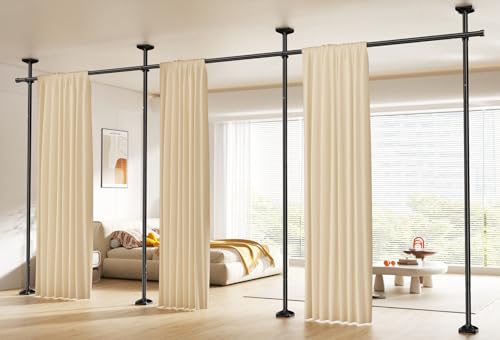
SUNALLY No-Drilling Tension Curtain Rod Divider (4-10 ft H, 28-114 in W)
Buyers with a high 9-10 foot ceiling who need a divider that actually reaches it.
Our take Check price for SUNALLY No-Drilling Tension Curtain Rod Divider (4-10 ft H, 28-114 in W) (opens in a new tab)
Best Wide-Span High-Ceiling Pick
SUNALLY No-Drilling Tension Curtain Rod Divider (4-10 ft H, 28-171 in W)
Buyers with a large open room and a high ceiling who need maximum width plus height.
Our take Check price for SUNALLY No-Drilling Tension Curtain Rod Divider (4-10 ft H, 28-171 in W) (opens in a new tab)

Best Budget High-Ceiling Pick
Goovilla No-Drilling Tension Curtain Rod Divider (4-10 ft H, 28-70 in W)
Budget buyers with a high ceiling and a narrower opening to cover.
Our take Check price for Goovilla No-Drilling Tension Curtain Rod Divider (4-10 ft H, 28-70 in W) (opens in a new tab)

Best Heavier-Duty High-Ceiling Pick
Bonpally No-Drilling Tension Curtain Rod Divider (4-10 ft H, 28-114 in W)
Buyers with a high ceiling who want a divider installed long-term without the tension loosening over months.
Our take Check price for Bonpally No-Drilling Tension Curtain Rod Divider (4-10 ft H, 28-114 in W) (opens in a new tab)

Height Flag: Standard Height, Not True Tall
Svimi 4-Panel Wood Folding Screen (67 in H)
Buyers with a standard 8-foot ceiling; not a genuine high-ceiling solution.
Our take Check price for Svimi 4-Panel Wood Folding Screen (67 in H) (opens in a new tab)

Height Flag: Standard Height at Minimum Extension
RANTILA Single Large Panel Room Divider (69.5 in H)
Buyers with a standard ceiling; not recommended if your ceiling is 9 ft or taller.
Our take Check price for RANTILA Single Large Panel Room Divider (69.5 in H) (opens in a new tab)

Height Flag: Bookshelf Height Unconfirmed for High Ceilings
IRONCK Triple Wide 6-Tier Bookcase with Back Fence
Buyers who want shelving plus a divider in a standard-height room, not a confirmed high-ceiling solution.
Our take Check price for IRONCK Triple Wide 6-Tier Bookcase with Back Fence (opens in a new tab)

Height Flag: Taller Than Most, Still Not True High-Ceiling
SUNALLY 6FT Folding Privacy Screen with Lockable Wheels (72 in H)
Buyers who want a taller-than-average, mobile screen and can accept a partial ceiling gap.
Our take Check price for SUNALLY 6FT Folding Privacy Screen with Lockable Wheels (72 in H) (opens in a new tab)
Our Picks
Best for High Ceilings1 of 8
SUNALLY No-Drilling Tension Curtain Rod Divider (4-10 ft H, 28-114 in W) on Amazon (opens in a new tab)
This is the honest top pick for a high ceiling in this list, since it's an adjustable tension rod that extends up to 10 feet, actually reaching a true 9 to 10-foot ceiling rather than falling short like a standard folding screen.
Best for
- Buyers with a high 9-10 foot ceiling who need a divider that actually reaches it.
Why we like it
It's a curtain-and-rod system rather than a rigid panel, so treat it as a floor-to-ceiling fabric divide rather than a solid partition.
As with any tension pole at full extension, tighten gradually and stop once it holds without excess force, over-tightening a fully extended pole is more likely to stress a high ceiling than a shorter one.
Key dimensions & specs
- 4-10 ft adjustable height, reaches high ceilings
- 28-114 in adjustable width
- Fabric curtain, no-drill tension mount
- Freestanding
Pros
- reaches a 9-10 ft high ceiling
- No-drill freestanding installation
- Closes the ceiling gap most screens leave open
Cons
- Fabric curtain, not a rigid solid panel
- Full extension increases tension-related stress on the ceiling surface
Best Wide-Span High-Ceiling Pick2 of 8
SUNALLY No-Drilling Tension Curtain Rod Divider (4-10 ft H, 28-171 in W) on Amazon (opens in a new tab)
The same high-ceiling-reaching 4 to 10-foot tension rod as the top pick, extended to a much wider 171-inch span for a large loft or open-plan room with both a high ceiling and a wide floor plan.
Best for
- Buyers with a large open room and a high ceiling who need maximum width plus height.
Why we like it
It's still a fabric curtain divider, not a rigid panel, so its floor-to-ceiling coverage comes from height plus drape rather than structural rigidity.
A wider curtain adds more total fabric weight to the rod, worth checking the rod's stated duty rating against a heavier or blackout-lined curtain if that's part of your plan. 5 stars across a smaller 271-rating sample, this is a solid but less-reviewed option than the narrower SUNALLY pick above.
Key dimensions & specs
- 4-10 ft adjustable height, reaches high ceilings
- 28-171 in adjustable width, widest in this list
- Fabric curtain, no-drill tension mount
- Freestanding
Pros
- reaches high ceilings at full extension
- Widest span in this guide, 171 inches
- Suits large loft or open-plan rooms
Cons
- Smaller 271-rating sample
- Heavier curtain fabric needs checking against rod's weight rating
Best Budget High-Ceiling Pick3 of 8
Goovilla No-Drilling Tension Curtain Rod Divider (4-10 ft H, 28-70 in W) on Amazon (opens in a new tab)
Another high-ceiling-capable pick with the same 4 to 10-foot extension range as the SUNALLY picks above, at a narrower 28 to 70-inch width and the lowest price in this guide.
Best for
- Budget buyers with a high ceiling and a narrower opening to cover.
Why we like it
It's a solid option for a narrower opening in a tall room rather than a full wide-room split.
At this price it's an easy way to test whether a tension-curtain approach solves a high-ceiling privacy need before committing to a wider or more expensive option.
Key dimensions & specs
- 4-10 ft adjustable height, reaches high ceilings
- 28-70 in adjustable width
- Fabric curtain, no-drill tension mount
- Freestanding
Pros
- reaches high ceilings, lowest price in this guide
- No-drill freestanding installation
Cons
- 70 in max width limits it to narrower openings
- Fabric only, no rigid panel
Best Heavier-Duty High-Ceiling Pick4 of 8
Bonpally No-Drilling Tension Curtain Rod Divider (4-10 ft H, 28-114 in W) on Amazon (opens in a new tab)
This tension rod reaches a high ceiling with the same 4 to 10-foot range as the other SUNALLY-style picks in this guide, with a firmer spring mechanism that holds tension more reliably at full extension over months of use.
Best for
- Buyers with a high ceiling who want a divider installed long-term without the tension loosening over months.
Why we like it
That matters more at height, since a fully extended tension pole under a high ceiling has more overall length to flex or loosen over time than a shorter one.
Key dimensions & specs
- 4-10 ft adjustable height, reaches high ceilings
- 28-114 in adjustable width
- Heavier-duty tension spring
- Freestanding
Pros
- reaches high ceilings
- Firmer spring holds tension better at full extension over time
Cons
- Firmer spring can be harder to install solo at full height
- Same ceiling-stress risk as any tension pole if over-tightened
Height Flag: Standard Height, Not True Tall5 of 8
Svimi 4-Panel Wood Folding Screen (67 in H) on Amazon (opens in a new tab)
An honest flag here: at 67 inches, this is a standard-height folding screen, not tall, and it will leave 2 feet or more of open gap under a real 9-foot ceiling.
Best for
- Buyers with a standard 8-foot ceiling; not a genuine high-ceiling solution.
Why we like it
It's a well-built rigid wood-panel screen with a nice decorative finish, but it does not solve a high-ceiling privacy or acoustic problem.
Key dimensions & specs
- 67 in height, standard, NOT tall for 9-10 ft ceilings
- 64 in width
- 4-panel solid wood construction
- Freestanding
Pros
- Well-built rigid wood construction
- Decorative look
Cons
- 67 in height leaves 2+ ft gap on a genuine high ceiling
- Not a real high-ceiling solution despite appearing in this search
Height Flag: Standard Height at Minimum Extension6 of 8
RANTILA Single Large Panel Room Divider (69.5 in H) on Amazon (opens in a new tab)
5 inches this single-panel screen is standard height, not tall, and it will leave a substantial gap under a true 9 to 10-foot ceiling.
Best for
- Buyers with a standard ceiling; not recommended if your ceiling is 9 ft or taller.
Why we like it
It appears in this shared product search because it's classified as a room divider, but its height alone doesn't address a high-ceiling use case. 3-star average, a fine pick for a standard-height room but not a genuine solution if your ceiling is actually 9 feet or taller. 5 in height leaves a real gap on a genuine high ceiling.
Key dimensions & specs
- 69.5 in height, standard, NOT tall for 9-10 ft ceilings
- 71 in width
- Single-panel fabric design
- Freestanding
Pros
- Affordable at $30.99
Cons
- 69.5 in height leaves a real gap on a genuine high ceiling
- Not an actual high-ceiling solution
Height Flag: Bookshelf Height Unconfirmed for High Ceilings7 of 8
IRONCK Triple Wide 6-Tier Bookcase with Back Fence on Amazon (opens in a new tab)
We're including this bookcase-style divider with a clear flag: its listing does not confirm an exact height tall enough to be considered high-ceiling-reaching, and standard bookcases in this general size class typically run in the same 65 to 72-inch range as the folding screens above, well short of a 9 to 10-foot ceiling.
Best for
- Buyers who want shelving plus a divider in a standard-height room, not a confirmed high-ceiling solution.
Key dimensions & specs
- Height not confirmed tall enough for 9-10 ft ceilings
- Triple-wide 6-tier bookcase with back fence
- Freestanding, needs anchoring
- Not primarily a height solution
Pros
- Doubles as functional book storage with privacy back fence
- Good for standard-height rooms
Cons
- Height not confirmed to reach a genuine high ceiling
- Freestanding tall furniture needs anchoring regardless of ceiling height
Height Flag: Taller Than Most, Still Not True High-Ceiling8 of 8
SUNALLY 6FT Folding Privacy Screen with Lockable Wheels (72 in H) on Amazon (opens in a new tab)
5-inch panels elsewhere in this shared product pool, but it's still well short of a genuine 9 to 10-foot ceiling.
Best for
- Buyers who want a taller-than-average, mobile screen and can accept a partial ceiling gap.
Why we like it
We're including it with a clear flag rather than presenting it as a true high-ceiling solution, since a 2-foot-plus gap still remains above it on a real high ceiling.
If you want the mobility of wheels and are willing to accept a partial gap, this is a reasonable middle ground. For a high ceiling, the tension-rod curtain picks earlier in this guide, or a ceiling track curtain system, are the more honest answer.
Key dimensions & specs
- 72 in height, taller than most in this pool but still NOT true high-ceiling coverage
- 88 in width, 4-panel with lockable wheels
- Freestanding, no drilling
- Rolls for repositioning
Pros
- Taller than most standard folding screens at 72 in
- Rolls into place without lifting
- Freestanding, no drilling
Cons
- Still leaves a real gap on a genuine 9-10 ft ceiling
How We Chose These Tall Room Dividers for High Ceilings
Each pick was assessed across 5 criteria weighted for real-world use.
- Honest height verification against 9-10 ft ceilings
- Checked each product's actual stated height or extension range against a genuine high ceiling, and flagged clearly which products are standard 65-72 inch height rather than true tall dividers.
- Tip-over risk at freestanding tall heights
- Weighed stability and anchoring needs for the taller freestanding pieces in this pool, since a 90+ inch freestanding screen is inherently more top-heavy than a standard-height one.
- Noted that even the tallest freestanding pick here provides visual privacy, not real sound blocking, and that any gap below a high ceiling further limits acoustic value.
- Ceiling track systems as the better high-ceiling alternative
- Compared freestanding options against ceiling-mounted curtain track systems, which are the more reliable choice for a high ceiling, though more permanent to install.
- Buyer feedback and rating volume
- Weighed star ratings alongside sample size across this shared product pool.
What to Look for in a Tall Room Divider for High Ceilings
Key buying criteria so you get the right fit the first time.
Check freestanding stability against your actual floor type, not just an empty room demo
A freestanding divider relies entirely on its own base footprint and panel angle for stability, with no wall support, and how well it actually stays upright varies depending on floor type, a divider that stands solidly on carpet can behave differently on hardwood or tile, and panels catching a draft from an HVAC vent can wobble more than expected.
This matters because a divider that looks stable in a still product photo can still tip or shift with regular foot traffic brushing past it.
Check reviews specifically for real-world stability mentions on floor types similar to yours, and check the base footprint width relative to the divider's height, since a taller divider needs a wider base to stay stable.
Confirm genuine sound dampening if acoustic privacy is the actual goal, not just visual blocking
A room divider marketed as "acoustic" should use a real sound-dampening material, typically a felt or fabric-wrapped panel core, that measurably reduces noise transmission, distinct from a simple solid panel or bookcase that only blocks the sightline without doing anything meaningful for sound.
This distinction matters directly if noise reduction for calls or focused work is your actual goal, since a purely visual divider does very little to dampen adjacent conversation or ambient noise regardless of how solid it looks.
Check the listing specifically for a stated acoustic material, not just the word "acoustic" in the title with no supporting material description.
Match panel height to your ceiling and the actual privacy level you need
Panel height determines both visual privacy and how much of the room's overall openness the divider preserves, a shorter divider maintains more light and airflow but offers less real privacy, while a taller divider that extends closer to the ceiling gives stronger separation at the cost of feeling like a more permanent wall.
This matters more in a room with a high ceiling, where a standard-height divider can look and feel undersized, and less in a room with a standard 8-foot ceiling where most divider heights work proportionally.
Check the listed divider height against your room's actual ceiling height and how much visual openness you want to preserve, not just the divider's general size category.
Weigh assembly and mounting requirements against whether you're renting or own the space
Room dividers span a wide range of setup requirements, from a no-drill freestanding panel that requires zero installation to a wall-mounted or track-based divider requiring drilling and potentially professional installation, and which one is appropriate depends heavily on whether you're in a rented space where drilling isn't an option, or a space you own where a more permanent installation is fine.
This matters directly for a renter, discovering after purchase that a divider requires wall-mounting hardware is a real and avoidable problem in a space where drilling isn't allowed.
Check the listing specifically for the mounting method, freestanding, no-drill, or requiring wall anchors, before ordering, especially in a rented space.
Consider mobility needs if the divider will move between rooms or configurations regularly
A divider on wheels or casters can be repositioned easily between rooms or reconfigured for different layouts throughout the week, useful for anyone who needs flexible zoning rather than a permanent room split, but wheels also mean the divider is inherently less stable than a fixed-base design and can shift underfoot if bumped.
This matters more if you need to move the divider often, like separating a home office from a living space only during work hours, less if it'll stay in one position long-term.
Check whether casters are lockable to prevent unwanted movement once positioned, and weigh mobility against the reduced stability it typically brings.
How to Choose a Tall Room Divider for High Ceilings
By Rating Confidence: Highest Rated vs Most Reviewed
| RANTILA Single Large Panel Room Divider |
On Wheels vs Fixed Base
- Repositionable between rooms or layouts, worth locking casters once positioned. In this comparison: SUNALLY 6FT Folding Privacy Screen with Lockable Wheels.
- More stable for a divider that stays in one spot long-term. In this comparison: SUNALLY No, SUNALLY No, Goovilla No, Bonpally No, Svimi 4, RANTILA Single Large Panel Room Divider, IRONCK Triple Wide 6.
Default to a fixed base unless you need to reposition the divider often.
For a Rented Space Specifically
- A genuine freestanding or no-drill design that requires zero wall modification, not a divider that turns out to need wall anchors.
- You need real acoustic dampening or a taller, more stable divider, where IRONCK Triple Wide 6's material and construction give real headroom over the cheaper picks.
- You just need light visual separation without noise or stability concerns, where Goovilla No covers the same job at a lower price.
Frequently Asked Questions
Do any of these room dividers actually reach a 9 or 10-foot ceiling?
Only the adjustable tension-rod curtain dividers in this guide, which extend 4 to 10 feet, reach a 9 to 10-foot ceiling. The rigid folding screens and single panels in this same product search typically run 65 to 72 inches tall, standard height, and leave a real gap under a true high ceiling.
Is a freestanding tall room divider safe without anchoring?
Freestanding units in the 90-inch-plus range, taller than the products in this specific guide, are inherently top-heavy and prone to tipping without anchoring. Even the 72-inch wheeled screen in this list benefits from careful, slow repositioning rather than assuming a tall base alone provides stability.
What's a better option than a freestanding screen for a high ceiling?
A ceiling-mounted curtain track system is often the more complete solution for a truly high ceiling, since it covers the full height reliably and doesn't depend on a freestanding base or a tension pole at full extension. It requires ceiling mounting and is more permanent, but it solves the height problem more thoroughly than any freestanding screen.
Does a taller room divider block more sound?
Height alone doesn't determine sound blocking, material density matters more. All the fabric tension-curtain and lightweight panel dividers in this guide provide visual privacy only, not real acoustic blocking, regardless of how tall they extend. Denser acoustic panel materials block sound better but are considerably heavier to install and move.
Why does a tall divider near an air vent make one side of the room stuffy?
A tall divider placed directly across an HVAC airflow path can block or redirect the air current, creating a pressure imbalance that leaves one side of the room stuffier or less ventilated than the other. Position any tall divider, including the tension-curtain picks in this guide, away from direct vent lines where possible.
Bottom Line
Best overall: SUNALLY No-Drilling Tension Curtain Rod Divider (4-10 ft H, 28-114 in W) — best for high ceilings pick in this roundup. See the full verdicts above for every pick, with pros, cons and who each one suits.
Browse all tall room dividers for high ceilings on Amazon — Prime-eligible options with current pricing.