
Buying Guide
The Best Narrow Room Dividers for Small Spaces: Our Picks
We looked at 8 narrow room dividers for small spaces side by side, with the trade-offs that separate them and who each one suits.
By Jamie Cole, Lead Product Researcher
9 min read8 products evaluated
We may earn a commission from purchases made through links in this guide. Learn more.
In a small bedroom, studio, or shared home office, floor space is the scarcest resource, and most shoppers assume a "narrow" room divider means a shorter overall span. In this product category, narrow almost always refers to the folded panel depth, the footprint the divider occupies when closed or pushed against a wall, not how wide it stretches once opened. A single-panel screen that folds down to 2 inches thick can still open to 6 or 7 feet wide.
That distinction matters more in small spaces than in large rooms, because a divider that eats 12 to 18 inches of floor depth when open, versus one that eats 2 to 4 inches, changes whether a small bedroom or dorm room still has usable walking space. Below are 8 room dividers we compared for folded depth, freestanding stability near vents and drafts, and how well they actually cover an 8-foot ceiling, not just listed dimensions.
Quick Picks
Our 8 recommendations at a glance. Tap a pick for the full verdict.

Best Overall Narrow Footprint
SUNALLY No-Drilling Tension Curtain Rod Room Divider (28-114 inch W)
Small bedrooms or studios that need the shallowest possible floor footprint and a close-to-ceiling fit.
Our take Check price for SUNALLY No-Drilling Tension Curtain Rod Room Divider (28-114 inch W) (opens in a new tab)

Best Budget Narrow Pick
Goovilla No-Drilling Tension Curtain Rod Divider (28-70 inch W)
A narrow closet nook, alcove, or corner where a full-width divider is not needed.
Our take Check price for Goovilla No-Drilling Tension Curtain Rod Divider (28-70 inch W) (opens in a new tab)

Best Heavy-Duty Tension Rod
Bonpally No-Drilling Tension Curtain Rod Divider (28-114 inch W)
Renters who want a tension-rod divider installed long-term without the spring loosening over months.
Our take Check price for Bonpally No-Drilling Tension Curtain Rod Divider (28-114 inch W) (opens in a new tab)
Best for Wide Rooms, Narrow Storage
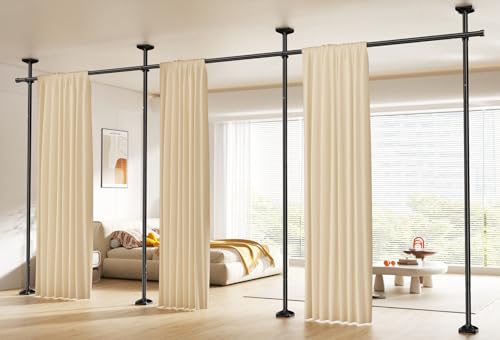
SUNALLY No-Drilling Tension Curtain Rod Divider (28-171 inch W)
A wide small-apartment room that still needs the shallowest floor-depth divider available.
Our take Check price for SUNALLY No-Drilling Tension Curtain Rod Divider (28-171 inch W) (opens in a new tab)

Best Rigid Narrow-Depth Panel
Svimi 4-Panel Wood Folding Screen (67 in H x 64 in W)
Buyers who want a rigid, narrow-folding divider with a decorative look rather than a plain curtain.
Our take Check price for Svimi 4-Panel Wood Folding Screen (67 in H x 64 in W) (opens in a new tab)

Best Single-Panel Freestanding
RANTILA Single Large Panel Room Divider (71 in W x 69.5 in H)
Buyers who want a single wide fabric panel with a narrower fold-flat storage profile than a multi-panel screen.
Our take Check price for RANTILA Single Large Panel Room Divider (71 in W x 69.5 in H) (opens in a new tab)

Best Narrow-Depth with Mobility
SUNALLY 6FT Folding Privacy Screen with Lockable Wheels (88 in W, 4 Panel)
Small-space renters who want a narrow-folding screen they can roll into place without lifting it.
Our take Check price for SUNALLY 6FT Folding Privacy Screen with Lockable Wheels (88 in W, 4 Panel) (opens in a new tab)
Best Height-Adjustable Single Panel
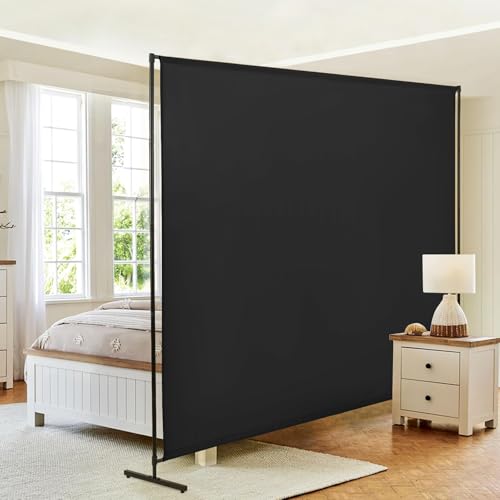
Single Panel Room Divider, Height Adjustable (71 in W x 71 in H)
Buyers who want a single narrow-folding panel with slight height adjustment and are comfortable with its lower rating.
Our take Check price for Single Panel Room Divider, Height Adjustable (71 in W x 71 in H) (opens in a new tab)
Our Picks
Best Overall Narrow Footprint1 of 8
SUNALLY No-Drilling Tension Curtain Rod Room Divider (28-114 inch W) on Amazon (opens in a new tab)
A tension-rod curtain divider is close to the narrowest option available for a small room, since the rod itself is under 2 inches deep and the curtain fabric folds flat for storage.
Best for
- Small bedrooms or studios that need the shallowest possible floor footprint and a close-to-ceiling fit.
Why we like it
This SUNALLY model extends 4 to 10 feet in height and 28 to 114 inches in width, which is enough range to reach an 8 to 9-foot ceiling and close most of the vertical gap that a standard 65 to 72-inch folding screen leaves open.
Because the fabric hangs from a spring-tensioned rod rather than a rigid frame, it moves slightly in a draft near an HVAC vent or a drafty window, which is worth knowing if the divider will sit near an air return.
Height adjusts to close the ceiling gap on 8 ft+ ceilings.
Key dimensions & specs
- Folded/rod depth under 2 inches
- 4-10 ft adjustable height
- 28-114 inch adjustable width
- No-drill tension mount
- Fabric curtain panel
Pros
- Among the narrowest folded/mounted depth in this list
- Height adjusts to close the ceiling gap on 8 ft+ ceilings
- No drilling required
Cons
- Fabric sways in HVAC drafts more than a rigid panel
- No true acoustic blocking, visual privacy only
Best Budget Narrow Pick2 of 8
Goovilla No-Drilling Tension Curtain Rod Divider (28-70 inch W) on Amazon (opens in a new tab)
, this is the lowest-priced narrow-footprint divider in this roundup, using the same tension-rod design as the SUNALLY above, a rod under 2 inches deep and a fabric panel that folds flat.
Best for
- A narrow closet nook, alcove, or corner where a full-width divider is not needed.
Why we like it
It covers a smaller 28 to 70-inch width range, which suits a narrow closet nook, a dorm bed alcove, or a corner partition rather than a full room split. Because it is lightweight, it needs a stable, level floor and a snug fit between the ceiling and floor to stay put; in a drafty room it will shift more than a weighted or heavier panel divider.
Key dimensions & specs
- Folded/rod depth under 2 inches
- 4-10 ft adjustable height
- 28-70 inch adjustable width
- No-drill tension mount
- Fabric curtain panel
Pros
- Lowest price in this narrow-divider roundup
- Rod depth under 2 inches
- Reaches close to the ceiling on tall walls
Cons
- 70 inch max width limits it to narrower openings
- Lightweight fabric needs a stable, draft-free spot
Best Heavy-Duty Tension Rod3 of 8
Bonpally No-Drilling Tension Curtain Rod Divider (28-114 inch W) on Amazon (opens in a new tab)
The Bonpally is marketed as heavy duty, referring to the tension mechanism's holding force rather than the panel's floor footprint, which stays under 2 inches like the other tension-rod options here.
Best for
- Renters who want a tension-rod divider installed long-term without the spring loosening over months.
Why we like it
It reaches 4 to 10 feet floor to ceiling and 28 to 114 inches wide, matching the SUNALLY's range for closing the gap on an 8-foot or taller ceiling.
A firmer tension spring reduces the wobble that lighter tension rods can develop over time, which matters if the divider will stay installed for months rather than a temporary use.
Reaches ceiling height on 8-9 ft rooms.
Key dimensions & specs
- Folded/rod depth under 2 inches
- 4-10 ft adjustable height
- 28-114 inch adjustable width
- No-drill tension mount, heavier-duty spring
- Fabric curtain panel
Pros
- Firmer tension spring than budget alternatives
- Reaches ceiling height on 8-9 ft rooms
- Narrow footprint under 2 inches
Cons
- Stiffer tension can be harder to install solo
- Fabric only, no rigid panel option
Best for Wide Rooms, Narrow Storage4 of 8
SUNALLY No-Drilling Tension Curtain Rod Divider (28-171 inch W) on Amazon (opens in a new tab)
This SUNALLY variant extends up to 171 inches wide, close to 14 feet, while keeping the same under-2-inch rod depth and 4 to 10-foot height range as the narrower models.
Best for
- A wide small-apartment room that still needs the shallowest floor-depth divider available.
Why we like it
It is the option to reach for when the room itself is wide but the buyer still wants the narrowest possible mounted profile rather than a bulky folding screen taking up floor depth.
At this width, expect more fabric to manage and store when not in use; the tradeoff for spanning a wide room with a shallow-depth divider is a larger folded fabric bundle for renters with limited closet space. 5-star rating, though with a smaller 271-rating sample than the other tension rods here.
Key dimensions & specs
- Folded/rod depth under 2 inches
- 4-10 ft adjustable height
- 28-171 inch adjustable width
- No-drill tension mount
- Fabric curtain panel
Pros
- Spans up to 171 inches, widest in this list
- Still under 2 inches deep when mounted
- Reaches 8-10 ft ceilings
- No drilling required
Cons
- Smaller 271-rating sample than other picks
- Larger folded fabric bundle to store
Best Rigid Narrow-Depth Panel5 of 8
Svimi 4-Panel Wood Folding Screen (67 in H x 64 in W) on Amazon (opens in a new tab)
Unlike the tension-rod curtains above, this is a rigid 4-panel folding screen, and here narrow means the folded stack depth, roughly the thickness of four hinged wood panels, not the 64-inch open width.
Best for
- Buyers who want a rigid, narrow-folding divider with a decorative look rather than a plain curtain.
Why we like it
The solid wood frame gives it more resistance to shifting near an HVAC vent or an open window draft than a lightweight fabric curtain.
At 67 inches tall, it falls short of an 8-foot ceiling by more than a foot, which leaves a visible gap above the panel and limits both privacy and any sound-dampening value. It is a better fit for visual separation in a room with a standard 8-foot ceiling than for a floor-to-ceiling divide, and it folds to a narrow stack for closet storage.
Folds to a narrow stack for storage.
Key dimensions & specs
- Folded stack depth roughly panel-thickness only
- 67 inch height, 64 inch width
- 4-panel solid wood hinge construction
- Freestanding, no drilling
Pros
- Rigid wood frame resists drafts better than fabric
- Folds to a narrow stack for storage
- Decorative wood-panel look
Cons
- 67 inch height leaves a real gap on 8 ft+ ceilings
- Heavier and pricier than tension-rod curtains
Best Single-Panel Freestanding6 of 8
RANTILA Single Large Panel Room Divider (71 in W x 69.5 in H) on Amazon (opens in a new tab)
A single-panel fabric screen has a real advantage in floor depth over a multi-panel folding screen, since there is only one panel to fold flat rather than a zig-zag stack, making it one of the narrower profiles in this list when stored.
Best for
- Buyers who want a single wide fabric panel with a narrower fold-flat storage profile than a multi-panel screen.
Why we like it
5 inches, it covers a fairly wide span for a single unbroken panel.
5 inches tall it, like the Svimi screen, falls well short of a full 8-foot ceiling and provides visual privacy only, not real acoustic separation. 3-star average is the lowest among the picks here.
3 stars, lowest average in this roundup.
Key dimensions & specs
- Single panel, narrow flat-fold storage
- 71 inch width, 69.5 inch height
- Freestanding fabric panel
- No drilling required
Pros
- Single-panel design folds narrower than multi-panel screens
- Affordable at $30.99
- Freestanding, no drilling
Cons
- 69.5 inch height leaves an 8 ft+ ceiling gap
Best Narrow-Depth with Mobility7 of 8
SUNALLY 6FT Folding Privacy Screen with Lockable Wheels (88 in W, 4 Panel) on Amazon (opens in a new tab)
This is a 4-panel folding fabric screen with lockable wheels attached to the base, which adds floor footprint at each caster point compared to a plain folding screen without wheels.
Best for
- Small-space renters who want a narrow-folding screen they can roll into place without lifting it.
Why we like it
It still folds to a narrow stack panel-to-panel, and the casters let a small-space renter reposition it without lifting the whole unit.
5-inch screens above, though a real gap still remains. The locking casters keep it from rolling unexpectedly once positioned, worth engaging every time it is moved into place.
Lockable wheels for easy repositioning.
Key dimensions & specs
- Folded panel stack, narrow when closed
- 6 ft (72 in) height, 88 in width
- 4-panel with lockable wheels
- Freestanding, no drilling
Pros
- 6 ft height closer to ceiling than shorter screens
- Lockable wheels for easy repositioning
- Folds to a narrow stack
- Freestanding, no drilling
Cons
- Casters add a small amount of base footprint
Best Height-Adjustable Single Panel8 of 8
Single Panel Room Divider, Height Adjustable (71 in W x 71 in H) on Amazon (opens in a new tab)
This single-panel screen adjusts in height and folds flat in the same narrow single-panel profile as the RANTILA above.
Best for
- Buyers who want a single narrow-folding panel with slight height adjustment and are comfortable with its lower rating.
Why we like it
At 71 inches tall its maximum adjusted height is still short of most 8-foot ceilings, so treat the height adjustment as a fit-to-space feature rather than a ceiling-to-floor solution.
9-star average across a smaller 170-rating sample, it is the lowest-rated option in this narrow-divider roundup, and buyers should weigh that against its otherwise similar narrow-fold profile to the RANTILA and other single-panel picks.
9 stars, lowest rating in this list.
Key dimensions & specs
- Single panel, narrow flat-fold storage
- 71 inch width, up to 71 inch adjustable height
- Freestanding fabric panel
- No drilling required
Pros
- Height adjustable within its range
- Narrow single-panel fold profile
- Affordable at $39.89
Cons
- Smaller 170-rating sample
- 71 in max height still leaves a ceiling gap on 8 ft+ rooms
How We Chose These Narrow Room Dividers for Small Spaces
Each pick was assessed across 5 criteria weighted for real-world use.
- Prioritized how little floor or wall depth each divider occupies when closed or installed, since this is what 'narrow' actually means in this category, not the open width.
- Compared each product's stated height against a standard 8-foot ceiling and flagged how much visible gap remains, since most folding screens fall well short of floor-to-ceiling coverage.
- Weighed rigid panel construction against lightweight fabric curtains for resistance to shifting near an air vent, window draft, or foot traffic.
- Folded storage size for renters
- Considered how much closet or storage space the divider needs when not in use, relevant for renters without a permanent spot to leave it set up.
- Buyer feedback and rating volume
- Weighed star rating alongside the number of ratings to avoid over-crediting a high average built on a small sample size.
What to Look for in a Narrow Room Divider for Small Spaces
Key buying criteria so you get the right fit the first time.
Check freestanding stability against your actual floor type, not just an empty room demo
A freestanding divider relies entirely on its own base footprint and panel angle for stability, with no wall support, and how well it actually stays upright varies depending on floor type, a divider that stands solidly on carpet can behave differently on hardwood or tile, and panels catching a draft from an HVAC vent can wobble more than expected.
This matters because a divider that looks stable in a still product photo can still tip or shift with regular foot traffic brushing past it.
Check reviews specifically for real-world stability mentions on floor types similar to yours, and check the base footprint width relative to the divider's height, since a taller divider needs a wider base to stay stable.
Confirm genuine sound dampening if acoustic privacy is the actual goal, not just visual blocking
A room divider marketed as "acoustic" should use a real sound-dampening material, typically a felt or fabric-wrapped panel core, that measurably reduces noise transmission, distinct from a simple solid panel or bookcase that only blocks the sightline without doing anything meaningful for sound.
This distinction matters directly if noise reduction for calls or focused work is your actual goal, since a purely visual divider does very little to dampen adjacent conversation or ambient noise regardless of how solid it looks.
Check the listing specifically for a stated acoustic material, not just the word "acoustic" in the title with no supporting material description.
Match panel height to your ceiling and the actual privacy level you need
Panel height determines both visual privacy and how much of the room's overall openness the divider preserves, a shorter divider maintains more light and airflow but offers less real privacy, while a taller divider that extends closer to the ceiling gives stronger separation at the cost of feeling like a more permanent wall.
This matters more in a room with a high ceiling, where a standard-height divider can look and feel undersized, and less in a room with a standard 8-foot ceiling where most divider heights work proportionally.
Check the listed divider height against your room's actual ceiling height and how much visual openness you want to preserve, not just the divider's general size category.
Weigh assembly and mounting requirements against whether you're renting or own the space
Room dividers span a wide range of setup requirements, from a no-drill freestanding panel that requires zero installation to a wall-mounted or track-based divider requiring drilling and potentially professional installation, and which one is appropriate depends heavily on whether you're in a rented space where drilling isn't an option, or a space you own where a more permanent installation is fine.
This matters directly for a renter, discovering after purchase that a divider requires wall-mounting hardware is a real and avoidable problem in a space where drilling isn't allowed.
Check the listing specifically for the mounting method, freestanding, no-drill, or requiring wall anchors, before ordering, especially in a rented space.
Consider mobility needs if the divider will move between rooms or configurations regularly
A divider on wheels or casters can be repositioned easily between rooms or reconfigured for different layouts throughout the week, useful for anyone who needs flexible zoning rather than a permanent room split, but wheels also mean the divider is inherently less stable than a fixed-base design and can shift underfoot if bumped.
This matters more if you need to move the divider often, like separating a home office from a living space only during work hours, less if it'll stay in one position long-term.
Check whether casters are lockable to prevent unwanted movement once positioned, and weigh mobility against the reduced stability it typically brings.
How to Choose a Narrow Room Divider for Small Spaces
By Rating Confidence: Highest Rated vs Most Reviewed
| RANTILA Single Large Panel Room Divider |
On Wheels vs Fixed Base
- Repositionable between rooms or layouts, worth locking casters once positioned. In this comparison: SUNALLY 6FT Folding Privacy Screen with Lockable Wheels.
- More stable for a divider that stays in one spot long-term. In this comparison: SUNALLY No, Goovilla No, Bonpally No, SUNALLY No, Svimi 4, RANTILA Single Large Panel Room Divider, Single Panel Room Divider.
Default to a fixed base unless you need to reposition the divider often.
| RANTILA Single Large Panel Room Divider | |
For a Rented Space Specifically
- A genuine freestanding or no-drill design that requires zero wall modification, not a divider that turns out to need wall anchors.
- You need real acoustic dampening or a taller, more stable divider, where Svimi 4's material and construction give real headroom over the cheaper picks.
- You just need light visual separation without noise or stability concerns, where Goovilla No covers the same job at a lower price.
Frequently Asked Questions
Does "narrow room divider" mean it takes up less floor space when open?
In this category, narrow usually describes the folded or mounted depth, how thick the divider is when closed or installed against a wall, not the width it covers when opened. A tension-rod curtain under 2 inches deep can still open to 10 feet wide, while a bulkier folding screen might have a narrower open width but a thicker folded stack.
Will a folding screen actually block sound between rooms?
Standard folding screens and curtain dividers provide visual privacy only. None of the picks in this guide are rated for real acoustic blocking, and the common 65 to 72-inch screen heights leave a gap below an 8-foot ceiling that further limits any sound-dampening effect. For actual sound reduction, look at heavier acoustic panel dividers rather than this product category.
Are tension-rod curtain dividers safe near heating and cooling vents?
They can shift or sway in consistent airflow since the fabric hangs loosely and the mount relies on spring tension rather than a rigid frame. If the divider will sit directly in front of an HVAC vent or a drafty window, a rigid folding wood screen holds its position better than a fabric tension curtain.
How much closet space do I need to store a folding room divider?
A single fabric tension curtain rolls into a small bundle and the rod breaks down to under 3 feet. A 4-panel folding screen folds flat but still needs enough vertical closet space to lean against a wall, roughly the panel height. Check the folded dimensions listed by the manufacturer if closet space is limited.
Will a room divider reach my ceiling?
Only the adjustable tension-rod curtain dividers in this guide, which extend 4 to 10 feet, come close to a full floor-to-ceiling fit on a standard 8 to 9-foot ceiling. Rigid folding screens in this category typically run 65 to 72 inches tall and will leave a visible gap on an 8-foot (96 inch) ceiling.
Bottom Line
Best overall: SUNALLY No-Drilling Tension Curtain Rod Room Divider (28-114 inch W) — best overall narrow footprint pick in this roundup. See the full verdicts above for every pick, with pros, cons and who each one suits.
Browse all narrow room dividers for small spaces on Amazon — Prime-eligible options with current pricing.