
Buying Guide
The Best PoE Injectors for IP Cameras, Compared
We looked at 4 PoE injectors for IP cameras side by side, with the trade-offs that separate them and who each one suits.
By Jamie Cole, Lead Product Researcher
9 min read4 products evaluated
We may earn a commission from purchases made through links in this guide. Learn more.
Powering an IP camera over PoE avoids running a separate electrical line to a mounting location, but the right injector depends heavily on your specific installation scenario, whether that's a single camera, two cameras near each other, or a bulk multi-camera installer job.
We compared this lineup on real installation scenarios rather than raw wattage alone, since one listing here specifically combines two cameras onto a single cable run to save on cabling costs, a different use case than a standard single-camera injector.
Quick Picks
Our 4 recommendations at a glance. Tap a pick for the full verdict.

Best for Reolink Cameras
REOLINK Gigabit Injector (RLA-PI1)
Buyers with Reolink PoE cameras, video doorbells, or floodlight cameras
Our take Check price for REOLINK Gigabit Injector (RLA-PI1) (opens in a new tab)

Best for Two Nearby Cameras
IPCamPower POE Combiner Splitter Adapter
Buyers installing two cameras near each other who want to avoid a second long cable run
Our take Check price for IPCamPower POE Combiner Splitter Adapter (opens in a new tab)
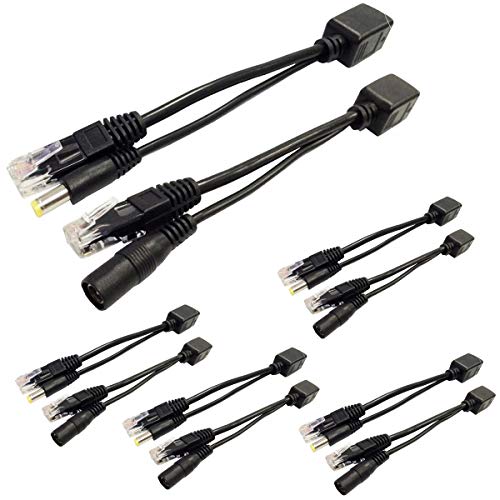
Best for Bulk Camera Installs
5 Pairs Passive PoE Injector and Splitter Kit
Installers or homeowners setting up multiple standard-definition cameras at once
Our take Check price for 5 Pairs Passive PoE Injector and Splitter Kit (opens in a new tab)

Best Budget Single Camera
PoE Texas Single-Port Mode B Passive PoE Injector
Buyers with a single camera who want Gigabit speed at the lowest single-unit price
Our take Check price for PoE Texas Single-Port Mode B Passive PoE Injector (opens in a new tab)
Our Picks
Best for Reolink Cameras1 of 4
REOLINK Gigabit Injector (RLA-PI1) on Amazon (opens in a new tab)
This injector's listing specifically states compatibility with Reolink PoE IP cameras, video doorbells, and floodlight cameras as a first-party accessory, removing any compatibility guesswork for buyers already using Reolink's camera ecosystem.
Best for
- Buyers with Reolink PoE cameras, video doorbells, or floodlight cameras
Why we like it
4W to standard PoE devices covers the range Reolink's own camera lineup typically needs.
Compared to the multi-camera combiner below, this one serves a single Reolink camera or device at a time, the standard single-device injector use case most buyers with one or two cameras actually need.
Best for buyers with Reolink PoE cameras, video doorbells, or floodlight cameras who want guaranteed first-party compatibility.
Key dimensions & specs
- Up to 30W PoE+ or 15.4W PoE
- Gigabit, up to 100m range
- Named Reolink camera/doorbell compatibility
Pros
- First-party Reolink compatibility removes guesswork
- Gigabit speed suits Reolink's higher-resolution camera models
- Plug and play with no configuration needed
Cons
- Not specifically validated for other camera brands
- Standard single-device injector, not for multi-camera runs
Best for Two Nearby Cameras2 of 4
IPCamPower POE Combiner Splitter Adapter on Amazon (opens in a new tab)
This kit's listing specifically states it lets you run one cable to a switch or NVR for two cameras installed near each other, using a sender combiner unit and a receiver splitter unit with weatherproof RJ45 connectors rated IP68 for full weather exposure.
Best for
- Buyers installing two cameras near each other who want to avoid a second long cable run
Why we like it
3af/at switches, NVRs, and cameras is broader than some competing combiners on the market.
Compared to the REOLINK pick above, this one solves a specific installation problem, avoiding a second long cable run when two cameras sit near each other, rather than simply powering one camera.
Best for buyers installing two cameras near each other who want to avoid running two separate long cables back to the switch or NVR.
Key dimensions & specs
- Combines 2 cameras onto 1 cable run
- IP68-rated splitter unit for full weather exposure
- Mode An and B PoE compatible
Pros
- Saves real cabling cost and labor for two nearby cameras
- IP68-rated receiver unit for full outdoor exposure
- Broad brand compatibility, not locked to Mode An or B only
Cons
- Only useful when two cameras are physically near each other
- Not a standard single-camera injector
Best for Bulk Camera Installs3 of 4
5 Pairs Passive PoE Injector and Splitter Kit on Amazon (opens in a new tab)
1mm DC connector, supporting any DC voltage up to 60V, making it a cost-effective bulk purchase for an installer setting up multiple cameras at once.
Best for
- Installers or homeowners setting up multiple standard-definition cameras at once
Why we like it
Its per-pair cost works out to about $2 each, a fraction of a single standard injector's price.
Compared to the single-unit picks above, this one is built for volume, an installer or homeowner setting up 5 cameras at once, rather than a one-off single-camera purchase.
Best for installers or homeowners setting up multiple cameras at once who want the lowest per-unit cost.
Key dimensions & specs
- 5 injector/splitter pairs (10 pieces total)
- Any DC voltage up to 60V, 10Mbps only
- 5.5x2.1mm DC connector
Pros
- Lowest per-unit cost in this comparison by a wide margin
- Bulk quantity suits a multi-camera installation project
- Works with any DC voltage up to 60V
Cons
- 10Mbps only, not suitable for high-resolution cameras
- Passive only, no standard 802.3af/at negotiation
Best Budget Single Camera4 of 4
PoE Texas Single-Port Mode B Passive PoE Injector on Amazon (opens in a new tab)
This injector's listing specifically states a compact, mountable design that screws into a wall near an outlet or under a desk, reducing clutter for a single-camera installation.
Best for
- Buyers with a single camera who want Gigabit speed at the lowest single-unit price
Why we like it
Its full Gigabit data speed (10/100/1000) at this low price point stands out compared to the 10Mbps bulk kit above.
Compared to the REOLINK pick above, this one costs $15 less and delivers full Gigabit speed for a single camera, though it requires you to supply your own 12-56V power adapter separately.
Best for buyers with a single camera who want Gigabit speed at the lowest single-unit price, and already have a compatible power adapter on hand.
Key dimensions & specs
- Passive PoE, 12-56V passthrough
- Gigabit data speed (10/100/1000)
- Compact, wall or desk mountable
Pros
- Full Gigabit speed at the lowest single-unit price
- Compact mountable design reduces installation clutter
- One year warranty with phone support
Cons
- Power supply sold separately, an added cost
- Passive only, requires matching your device's exact voltage
How We Chose These PoE Injectors for IP Cameras
Each pick was assessed across 5 criteria weighted for real-world use.
- Compared single-camera, multi-camera-combiner, and bulk-installer use cases separately rather than by wattage alone.
- Compared first-party brand-specific injectors against generic multi-brand compatibility.
- Compared Gigabit versus 10/100Mbps port speeds relative to typical camera resolution needs.
- Compared real per-unit cost for bulk kits against standard single-unit injector pricing.
- Compared stated IP ratings for outdoor-exposed components.
What to Look for in a PoE Injector for IP Cameras
Key buying criteria so you get the right fit the first time.
A First-Party Brand-Specific Injector Removes Compatibility Guesswork for That Specific Camera Ecosystem
3af/at camera but occasionally surfaces brand-specific quirks. This matters more if you've had a prior compatibility issue with a generic injector and a specific camera brand, and matters less if you're comfortable troubleshooting a generic unit. Consider a first-party injector specifically when one exists for your camera brand and removing that variable is worth a modest price premium.
Combining Two Cameras Onto One Cable Run Requires a Different Product Than a Standard Injector
A standard PoE injector powers exactly one device per cable run, while a combiner-splitter kit specifically merges the signal and power for two separate cameras onto a single shared cable back to the switch, then splits them apart again near the camera locations, a real installation-cost saver when two cameras sit physically close together. This matters significantly if you're installing two cameras at the same corner of a building or room and want to avoid running two separate long cables, and matters not at all if your cameras are spread across different areas of a property. Confirm your specific camera placement layout before choosing a combiner kit over standard individual injectors.
Bulk Multi-Camera Kits Deliver a Much Lower Per-Unit Cost but Typically Sacrifice Speed and Standard Negotiation
This matters significantly for an installer working on a large multi-camera job with standard-definition cameras where the speed tradeoff is irrelevant, and matters much less for a single high-resolution 4K camera that needs Gigabit throughput. Match the bulk kit's speed and power delivery limitations against your specific cameras' actual requirements before buying in volume.
IP Rating on Just One Component of a Kit Doesn't Mean the Entire Kit Is Outdoor-Rated
A combiner-splitter kit may state an IP68 rating specifically on its receiver splitter unit, the component actually exposed to weather near the camera, while the sender combiner unit that stays indoors near your switch has no such rating and shouldn't be installed outdoors. This matters because assuming an entire kit shares one uniform weatherproofing rating could lead you to install an indoor-only component outdoors by mistake. Check which specific component of a multi-part kit carries the outdoor rating before planning your installation locations.
Passive PoE in a Budget Kit Requires You to Separately Match Your Device's Exact Voltage
3af/at injector that handles this automatically. This matters if you're not confident about matching voltage specifications correctly, where a standard negotiated injector removes that risk, and matters less if you already know your camera's exact voltage requirement and have a compatible adapter. Check whether a budget passive option requires a separately purchased, voltage-matched power adapter before assuming the low sticker price is the complete cost.
How to Choose a PoE Injector for IP Cameras
| Single Reolink camera or device | |
|---|---|
| Two cameras installed near each other | |
| 5+ cameras, bulk installer job | 5 Pairs Passive PoE Injector Kit |
| PoE Texas Single-Port Mode B Injector |
Single-Camera Injector vs Two-Camera Combiner Kit
- Single-camera injector (REOLINK, PoE Texas)
- The standard choice when you have one camera per cable run back to your switch or NVR.
- Saves a full separate cable run when two cameras are physically near each other, combining their signal and power onto one shared cable back to the switch.
The combiner kit only makes sense when two cameras are close together; for cameras in different locations, standard single injectors per camera remain the simpler choice.
| REOLINK Gigabit Injector or PoE Texas (both Gigabit) | |
| 5 Pairs Passive PoE Injector Kit (10Mbps) |
For an Outdoor Camera Installation Specifically
- An IP-rated component wherever the hardware will actually be exposed to weather, not just a generic waterproof claim covering the whole kit.
- The IPCamPower kit specifically states its receiver splitter unit is IP68-rated for full exposure to rain, sleet, snow, and sun.
- You have a Reolink camera or two cameras near each other needing a combiner, where the REOLINK or IPCamPower picks solve those specific scenarios that a basic injector can't.
- You're installing several standard-definition cameras at once, where the bulk 5-pair kit's roughly $2 per-unit cost beats buying individual injectors.
Frequently Asked Questions
Do I need a brand-specific PoE injector for my security camera?
3af/at PoE injector, but a first-party injector from your camera's manufacturer removes any small compatibility uncertainty a generic unit might introduce.
When does a two-camera combiner kit make sense over two separate injectors?
Specifically when two cameras are installed near each other and you want to avoid running two separate long cables back to your switch or NVR, saving real cabling cost and installation time.
Is a bulk passive injector kit good enough for a 4K security camera?
No, bulk passive kits are typically limited to 10Mbps speed, which will bottleneck a high-resolution 4K camera; use a Gigabit-rated injector for higher-resolution cameras instead.
What's the most common mistake when installing a PoE injector for a camera?
Assuming a passive PoE injector's voltage automatically matches your camera's requirement, when in fact you must separately confirm and supply a compatible power adapter at the correct voltage for a passive setup.
Can I use a two-camera combiner kit outdoors?
Check which specific component is IP-rated; typically only the receiver splitter unit near the cameras is weatherproof, while the sender combiner unit near your switch should stay indoors.
How much does a bulk multi-camera injector kit typically save compared to individual injectors?
A 5-pair bulk kit can cost roughly $2 per pair compared to $10-25 for a single standard injector, a significant saving for an installer working on multiple standard-definition cameras at once.
Bottom Line
Best overall: REOLINK Gigabit Injector (RLA-PI1) — best for reolink cameras pick in this roundup. See the full verdicts above for every pick, with pros, cons and who each one suits.
Browse all poe injectors for ip cameras on Amazon — Prime-eligible options with current pricing.