
Buying Guide
The Best Laptop Screen Extenders Under $300: Our Picks
We looked at 4 laptop screen extenders under $300 side by side, with the trade-offs that separate them and who each one suits.
By Jamie Cole, Lead Product Researcher
8 min read4 products evaluated
We may earn a commission from purchases made through links in this guide. Learn more.
With a $300 ceiling, this comparison covers the full range of triple-screen extenders currently available, from standard 1080P setups to sharper 1200P panels, giving buyers real headroom to pick based on features rather than settling for whatever fits a tighter budget.
We compared this lineup on stated brightness and viewing angle, total setup weight, and the genuine capability differences between tiers, since at this price point the honest question isn't whether you can afford a triple-screen rig, but which specific one actually fits your workflow.
Quick Picks
Our 4 recommendations at a glance. Tap a pick for the full verdict.

Best Overall
P7 Triple Laptop Screen Extender 15.6" (300 Nits)
Buyers who want the brightest triple-screen panels available at a manageable weight
Our take Check price for P7 Triple Laptop Screen Extender 15.6" (300 Nits) (opens in a new tab)

Best for Vertical Workspace
S12 Triple Portable Monitor 16" 1200P
Buyers who want maximum vertical workspace for coding and spreadsheet-heavy work
Our take Check price for S12 Triple Portable Monitor 16" 1200P (opens in a new tab)
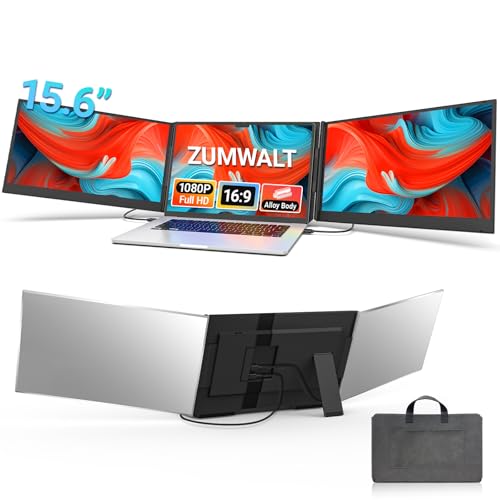
Best Value Triple-Screen
ZUMWALT P7 Triple Portable Monitor 15.6"
Buyers who want triple-screen productivity while saving on incremental brightness or resolution
Our take Check price for ZUMWALT P7 Triple Portable Monitor 15.6" (opens in a new tab)

Best Compact Alternative
Laptop Screen Extender 15.6" Detachable (Slim 0.27")
Buyers who realize a single detachable screen fits their needs better than a triple-screen rig
Our take Check price for Laptop Screen Extender 15.6" Detachable (Slim 0.27") (opens in a new tab)
Our Picks
Best Overall1 of 4
P7 Triple Laptop Screen Extender 15.6" (300 Nits) on Amazon (opens in a new tab)
6 inch 1080P IPS panels at 300 nits of brightness, a step up from the 280 nit ZUMWALT pick covered in our under $200 and under $250 guides, with the same 178 degree viewing angle and clip-free, top-baffle-free design that reduces stress on your laptop's hinge.
Best for
- Buyers who want the brightest triple-screen panels available at a manageable weight
Why we like it
9 lbs total, it's actually lighter than the standard ZUMWALT P7 triple-screen pick despite the brightness upgrade, and includes a premium carrying case for transport. Like other triple-screen extenders in this niche, it requires two full-featured USB-C ports for the simplest setup, and MacBook M1/M2/M3 users without one will need an additional H5-T cable, HDMI, and USB-A connection not included in the box.
Best for buyers who want the brightest 1080P triple-screen panels in this comparison at a lighter total weight than the standard-brightness alternative.
Key dimensions & specs
- Dual 15.6" FHD 1080P IPS, 300 nits, 178 degree viewing
- 3.9 lbs total, includes premium carrying case
- 2 USB-C cable setup, clip-free hinge-friendly design
Pros
- Brightest 1080P triple-screen panels in this comparison at 300 nits
- Lighter total weight than the standard ZUMWALT triple-screen pick
- Includes a premium carrying case for transport
Cons
- MacBook M1/M2/M3 users may need an extra H5-T cable not included
- Costs $70 more than the 280 nit ZUMWALT triple-screen pick
Best for Vertical Workspace2 of 4
S12 Triple Portable Monitor 16" 1200P on Amazon (opens in a new tab)
This is the same 16 inch 1200P triple-screen pick featured in our under $250 guide, included here because at $10 below the 300 nit P7 pick above, the choice between them comes down entirely to whether you value resolution and vertical workspace or raw brightness more for your specific work.
Best for
- Buyers who want maximum vertical workspace for coding and spreadsheet-heavy work
Why we like it
Its 1920x1200 resolution and 16:10 aspect ratio show more spreadsheet rows and code lines than the 1080P panels on the other picks in this guide, and its CNC-machined aluminum build with a hollow-center cooling design is a different construction approach than the standard aluminum shells elsewhere in this comparison.
Best for buyers who specifically want more vertical workspace for coding, spreadsheets, or documents over the brighter but standard-resolution 1080P alternative above.
Key dimensions & specs
- Dual 16" 1200P IPS, 1920x1200, 16:10 ratio, 350 nits
- CNC aerospace-grade aluminum, hollow-center cooling design
- Open-frame, clamp-free, works with 2 USB-C cables
Pros
- 1200P resolution and 16:10 ratio show more content than 1080P rivals
- Actually has higher stated brightness (350 nits) than the P7 pick
- Premium CNC aluminum build with dedicated cooling design
Cons
- Still needs two full-featured USB-C ports for the simplest setup
- 16:10 ratio may show slightly smaller UI elements without display scaling adjustments
Best Value Triple-Screen3 of 4
ZUMWALT P7 Triple Portable Monitor 15.6" on Amazon (opens in a new tab)
For buyers who want triple-screen productivity without paying near the $300 ceiling of this guide, this pick delivers the core two-panel setup at 280 nits and 1080P resolution for $60-70 less than the pricier picks above, while sharing the same clip-free, 2-cable USB-C design.
Best for
- Buyers who want triple-screen productivity while saving on incremental brightness or resolution
Why we like it
Against both pricier picks in this comparison, it gives up either the extra brightness of the P7 300-nit pick or the vertical workspace of the S12's 1200P panels, but for buyers who don't specifically need either upgrade, the savings are substantial relative to the modest real-world difference.
Best for buyers who want a genuine triple-screen setup and would rather save $60-70 than pay for incremental brightness or resolution gains.
Key dimensions & specs
- Dual 15.6" FHD 1080P, 280 nits, aluminum shell
- 4 lbs total, includes carrying bag
- 2 USB-C cable setup, clip-free hinge-friendly design
Pros
- Genuine triple-screen setup for $60-70 less than the pricier picks
- Same clip-free, hinge-friendly design as pricier alternatives
- Includes carrying bag and all cables in the box
Cons
- Lower brightness than the 300 nit P7 pick above
- Standard 1080P resolution versus the S12's sharper 1200P panels
Best Compact Alternative4 of 4
Laptop Screen Extender 15.6" Detachable (Slim 0.27") on Amazon (opens in a new tab)
Rounding out this $300-ceiling comparison, this detachable single-panel option costs less than half of any triple-screen pick above, a real option for buyers exploring this price range who ultimately decide they don't need a full triple-screen rig after all.
Best for
- Buyers who realize a single detachable screen fits their needs better than a triple-screen rig
Why we like it
27 inches thick with a 280 nit, 178 degree viewing panel, it delivers a detachable extra screen with none of the two-port USB-C requirements or MacBook cable caveats that come with the triple-screen picks in this guide.
Best for buyers shopping in this price range who realize a single detachable screen actually covers their needs better than a triple-screen setup.
Key dimensions & specs
- 15.6" FHD IPS, 280 nits, 178 degree viewing angle
- 0.27" thin, detachable design
- Single-cable setup, no triple-screen complexity
Pros
- Costs less than half of any triple-screen pick in this guide
- detaches for standalone monitor flexibility
- No MacBook M-series cable caveats to worry about
Cons
- Single extra screen only, not a triple-screen setup
- Standard 1080P resolution, no 1200P option
How We Chose These Laptop Screen Extenders Under $300
Each pick was assessed across 5 criteria weighted for real-world use.
- Brightness and Viewing Angle Across Tiers
- Compared stated nit brightness and viewing angle figures across all triple-screen picks, since these vary even among similarly priced triple-screen setups.
- Weighed the genuine benefit of 1200P resolution and a 16:10 aspect ratio against the alternative of higher stated brightness on a standard 1080P panel.
- Compared stated total weight figures across triple-screen picks, since weight varies meaningfully even between similarly specced two-panel setups.
- Checked which triple-screen listings explicitly disclose extra hardware requirements for MacBook M1/M2/M3 users lacking full-featured USB-C ports.
- Price-to-Feature Justification at the Top of This Range
- Assessed whether the priciest picks in this guide justify their cost with a distinct capability, brightness, resolution, or build material, rather than incremental branding.
What to Look for in a Laptop Screen Extender Under $300
Key buying criteria so you get the right fit the first time.
Don't Assume the Priciest Pick Automatically Has the Best Specs
99 P7 pick (300 nits), because the S12's premium comes from its 1200P resolution and CNC aluminum build, not from brightness. Before assuming a higher price means better specs across the board, compare each individual figure, brightness, resolution, weight, separately rather than treating price as a single ranking signal.
A Slightly Heavier Triple-Screen Setup Isn't Always the More Feature-Rich One
Weight differences between triple-screen extenders in this range come from panel size, frame material, and internal battery reserve, not necessarily from added features. 9 lb setup and a 4 lb setup in this comparison offer essentially the same triple-screen capability, so weight alone shouldn't be read as a proxy for build quality or feature richness. Check the specific listed weight number and weigh it against your own portability needs rather than assuming lighter or heavier correlates with better.
Decide Between Brightness and Resolution Based on Your Actual Environment, Not Marketing Language
Higher brightness (measured in nits) matters more if you work near windows or in well-lit rooms where screen glare is a real problem, while higher resolution and a taller aspect ratio matter more for detail-dense work like coding or spreadsheets regardless of lighting. Both marketing terms sound like unconditional upgrades, but each solves a different problem, so identify which constraint actually affects your daily work before picking based on whichever number sounds bigger.
At This Price Point, Compare the Cost of Three Different Tiers, Not Just Two
With a $300 ceiling, you have genuine choices spanning from a $110 single detachable panel through two different triple-screen options in the $190-260 range, meaning the honest comparison isn't just "triple-screen or not" but which specific triple-screen configuration, or whether a single panel, actually fits your budget and workflow best. Map out what each tier specifically adds over the one below it rather than defaulting to the most expensive option because it's within budget.
A Carrying Case Included in the Box Is a Real Added Value at This Price
Some triple-screen extenders in this range explicitly include a padded or premium carrying case for transport, while others require buying one separately if you plan to move the setup between locations regularly. Given that a triple-screen rig is bulkier and more fragile to transport than a single panel, a listing that includes a dedicated case is providing real added value worth factoring into a price comparison, not just an afterthought accessory.
How to Choose a Laptop Screen Extender Under $300
| The brightest 1080P triple-screen panels | |
|---|---|
| Maximum vertical workspace for coding or spreadsheets | S12 Triple Portable Monitor 16" 1200P |
| Triple-screen productivity at the lowest price |
300 Nits 1080P vs 350 Nits 1200P
- P7 Triple Screen 300 Nits (1080P)
- 9 lbs, best if brightness in well-lit rooms matters most to you.
- S12 Triple Screen 1200P (350 Nits)
- Actually brighter at 350 nits and adds a taller 16:10 aspect ratio for more vertical content, at a slightly lower price than the P7 pick.
The S12 pick wins on both resolution and brightness, so it's the stronger choice unless the P7's lighter weight specifically matters more for how you'll use the setup.
| 6" Detachable at a fraction of triple-screen weight |
For Home Office Multi-Monitor Setups Specifically
- The highest resolution and largest usable screen area, since a fixed home office desk doesn't need to prioritize portability the way a travel setup would.
- The S12 Triple Portable Monitor 16" 1200P is the strongest fit, offering both higher resolution and larger 16 inch panels for a stationary desk setup.
- You want the sharpest, brightest triple-screen setup available, where the S12 Triple Portable Monitor 16" 1200P delivers both higher resolution and higher brightness than the standard 1080P alternatives.
- 48 covers the same core need for well under half the price.
Frequently Asked Questions
Which triple-screen pick in this guide has the best overall specs?
98 has the edge, combining higher resolution, a taller 16:10 aspect ratio, and higher stated brightness (350 nits) than the pricier P7 pick, making it the strongest all-around choice in this comparison.
Is it worth paying $70 more for the P7's 300 nit brightness over the ZUMWALT's 280 nits?
For most buyers, no, since a 20 nit difference is a modest, often barely noticeable improvement. The larger, more relevant differences in this guide are between 1080P and 1200P resolution or between triple-screen and single-panel setups, not small brightness increments within the same resolution tier.
Do all the triple-screen extenders in this guide need the same MacBook M-series workaround?
Yes, every triple-screen pick in this comparison that requires two full-featured USB-C ports for its simplest setup will need the additional H5-T cable, HDMI, and USB-A workaround for MacBook M1/M2/M3 models lacking that port configuration, since this is a hardware limitation shared across this product category, not specific to one brand.
How do I decide between the 1200P S12 and the 300 nit P7 if I do both coding and video work?
If you had to choose one factor, resolution and aspect ratio generally matter more for coding specifically, since more vertical lines visible at once directly speeds up reading and navigating code, while the brightness difference between these two picks is small enough to matter less across both use cases.
Can I use just one of the two panels in a triple-screen extender if I don't need both?
Most triple-screen kits are designed to run both panels together as part of the mounting mechanism, and using only one panel typically isn't a supported configuration since the frame is built around the laptop sitting between both screens. If you only want one extra screen, a dedicated single-panel detachable extender is the better purchase from the start.
Does the included carrying case affect the overall weight I'll be carrying?
The case itself adds some weight beyond the extender's own stated figure, but it's generally a modest addition relative to the panels themselves, and the protection it provides during transport is usually worth the small extra weight if you move the setup between locations often.
Bottom Line
Best overall: P7 Triple Laptop Screen Extender 15.6" (300 Nits) — best overall pick in this roundup. See the full verdicts above for every pick, with pros, cons and who each one suits.
Browse all laptop screen extenders under $300 on Amazon — Prime-eligible options with current pricing.