
Buying Guide
The Best ASUS Laptop Locks for Everyday Desk Work
We looked at 5 ASUS laptop locks side by side, with the trade-offs that separate them and who each one suits.
By Jamie Cole, Lead Product Researcher
8 min read5 products evaluated
We may earn a commission from purchases made through links in this guide. Learn more.
ASUS spans consumer, gaming, business, and education lines that vary in security-slot availability and standard, so we required exact-model documentation rather than a brand-wide compatibility claim before including any pick here.
Most ASUS business and ZenBook-class laptops use the Standard T-Bar slot, but confirm your specific model since gaming-focused ROG laptops in particular don't always prioritize a dedicated security slot the way business lines do.
Quick Picks
Our 5 recommendations at a glance. Tap a pick for the full verdict.

Best Overall (Standard Slot)
Kensington Combination Cable T-Bar Standard Lock, K64673AM
ZenBook or VivoBook owners on a confirmed Standard slot wanting the most-proven lock here.
Our take Check price for Kensington Combination Cable T-Bar Standard Lock, K64673AM (opens in a new tab)

Best for Thin ASUS Models (Nano Slot)
Kensington NanoSaver Combination Laptop Lock, K60603WW
ASUS owners confirmed to use the Nano slot rather than Standard.
Our take Check price for Kensington NanoSaver Combination Laptop Lock, K60603WW (opens in a new tab)

Best Slim Standard-Slot Option
Kensington Slim Combination T-Bar Standard Lock, K60600WW
Thin ZenBook or ultrabook-class ASUS owners wanting a slim lock head.
Our take Check price for Kensington Slim Combination T-Bar Standard Lock, K60600WW (opens in a new tab)
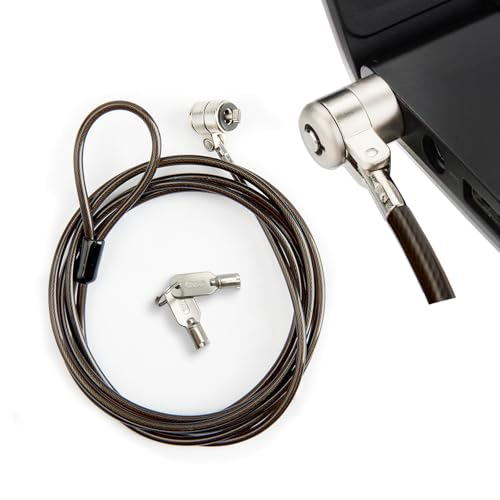
Best Budget 3x7mm Option
Laptop Lock, 6.6ft Anti-Theft Security Cable, 3x7mm Lock Hole
Budget-focused ASUS owners wanting the longest cable at a low price.
Our take Check price for Laptop Lock, 6.6ft Anti-Theft Security Cable, 3x7mm Lock Hole (opens in a new tab)

Best 2-Pack Value
2 Pack Laptop Cable Lock, 6.6 Feet Anti-Theft Security Steel Lock
Buyers needing two locks at once for shared ASUS devices, aware of the thinner track record.
Our take Check price for 2 Pack Laptop Cable Lock, 6.6 Feet Anti-Theft Security Steel Lock (opens in a new tab)
Our Picks
Best Overall (Standard Slot)1 of 5
Kensington Combination Cable T-Bar Standard Lock, K64673AM on Amazon (opens in a new tab)
Explicitly named ASUS-compatible in Kensington's documentation for the Standard T-Bar slot, covering most mainstream ASUS laptops including ZenBook and VivoBook lines.
Best for
- ZenBook or VivoBook owners on a confirmed Standard slot wanting the most-proven lock here.
Why we like it
A resettable 4-wheel dial gives 10,000 possible codes with independent torque and pull testing.
On price, it comes in below Kensington NanoSaver Combination Laptop Lock, which is worth weighing if cost is your deciding factor between the two.
On the other side, Standard slot only.
Key dimensions & specs
- Resettable 4-wheel dial, 10,000 combinations
- Standard T-Bar slot, ASUS-named compatibility per Kensington
- Independently torque and pull tested
Pros
- Explicit ASUS compatibility named in Kensington's documentation
Cons
- Not compatible with ASUS models using a different slot standard
- Standard slot only
Best for Thin ASUS Models (Nano Slot)2 of 5
Kensington NanoSaver Combination Laptop Lock, K60603WW on Amazon (opens in a new tab)
Built for select thin ASUS laptops using Kensington's Nano slot, with a slim head sized so the laptop lies flat once locked.
Best for
- ASUS owners confirmed to use the Nano slot rather than Standard.
Why we like it
On the other side, Priced above the equivalent Standard-slot lock.
Key dimensions & specs
- Nano slot, select thin ASUS models
- Resettable 4-wheel dial with online code recovery
- 2-year warranty, lifetime technical support
Pros
- Online code recovery if you forget your combination
- Slim head avoids blocking ports on thin ASUS devices
Cons
- Nano slot only, a narrow compatibility pool
- Priced above the equivalent Standard-slot lock
Best Slim Standard-Slot Option3 of 5
Kensington Slim Combination T-Bar Standard Lock, K60600WW on Amazon (opens in a new tab)
Purpose-built for thin and light laptops with a slim lock head that won't raise the chassis off its surface, explicitly naming HP, Lenovo, Acer, and Asus among compatible brands for the Standard slot.
Best for
- Thin ZenBook or ultrabook-class ASUS owners wanting a slim lock head.
Why we like it
This solves a real problem the standard-thickness Kensington T-Bar lock doesn't address on ASUS's thinner ZenBook models.
On the other side, Explicitly incompatible with Dell or Alienware laptops.
Key dimensions & specs
- Slim lock head designed for thin and light laptops
- Standard T-Bar slot, ASUS-named compatibility
- Resettable 4-wheel dial, 10,000 combinations
Pros
- Slim head specifically avoids raising thin ASUS laptops off their surface
- Explicit ASUS brand naming in Kensington's compatibility documentation
Cons
- Priced above the standard-thickness Kensington T-Bar lock
- Explicitly incompatible with Dell or Alienware laptops
Best Budget 3x7mm Option4 of 5
Laptop Lock, 6.6ft Anti-Theft Security Cable, 3x7mm Lock Hole on Amazon (opens in a new tab)
6 feet the longest cable in this comparison for a budget price.
Best for
- Budget-focused ASUS owners wanting the longest cable at a low price.
Why we like it
A zinc alloy lock head and reinforced steel cable are cut-resistant and waterproof.
The real tradeoff against that pick: Uses generic 3x7mm terminology rather than Kensington's standard naming.
On the other side, No documented warranty length in the listing.
Key dimensions & specs
- 6.6 ft cable, longest in this comparison
- 3x7mm T-Bar Standard slot, Asus named compatible
- 2 keys included
Pros
- Longest cable of any pick in this comparison
- Lowest price alongside the ASUS-specific 2-pack below
Cons
- Uses generic 3x7mm terminology rather than Kensington's standard naming
- No documented warranty length in the listing
Best 2-Pack Value5 of 5
2 Pack Laptop Cable Lock, 6.6 Feet Anti-Theft Security Steel Lock on Amazon (opens in a new tab)
Two full locks for its price, explicitly naming Asus compatibility for the standard 3x7mm T-slot, with a 360-degree pivoting head to avoid winding or twisting the steel cord on a tight desk.
Best for
- Buyers needing two locks at once for shared ASUS devices, aware of the thinner track record.
Why we like it
Each pack includes 2 locks plus 4 matching keys, designed for shared office use or corporate bulk deployment.
Key dimensions & specs
- 2 locks + 4 keys included, 6.6 ft each
- 3x7mm T-slot, Asus named compatible
- 360-degree pivoting lock head
Pros
- Two full locks in one purchase for shared or multi-device use
- 360-degree head pivot avoids cable winding on tight desks
Cons
- Lowest rating in this comparison at 3.9 stars
- Very thin review base of only 6 ratings
How We Chose These ASUS Laptop Locks
Each pick was assessed across 4 criteria weighted for real-world use.
- Required exact-model documentation, not a brand-wide claim
- ASUS spans consumer, gaming, and business lines with varying slot availability, so we checked each pick against documented ASUS compatibility rather than assuming universal fit.
- Distinguished slim and standard-thickness lock heads
- ASUS's thinner ZenBook-class laptops benefit from a slim lock head that won't raise the chassis off its surface, a real design difference we surfaced explicitly.
- We sorted picks by which of ASUS's two documented slot standards they fit, rather than treating all Kensington locks as interchangeable across ASUS models.
- Flagged thin review histories on newer budget picks
What to Look for in an ASUS Laptop Lock
Key buying criteria so you get the right fit the first time.
Confirm your exact laptop's security slot type, since it varies by model and generation, not just brand
Laptop security slots come in a handful of different physical standards, most commonly the Kensington Standard T-Bar slot (the original, widest design), the smaller Kensington Nano slot found on select thin and light models, and the Noble Wedge slot used by some other manufacturers, and these are not interchangeable, a lock built for one slot type simply will not physically engage a different slot shape.
This is not a brand-wide constant either: a manufacturer's lineup commonly mixes slot types across different model lines and even across generations of the same model line as laptops get thinner over time, so a lock confirmed compatible with one specific model doesn't guarantee compatibility with a different model from the same brand.
Check your exact laptop's model number and generation against the lock manufacturer's own documented compatibility list, rather than trusting a generic "fits all laptops" or brand-name-only claim from a retailer listing.
Choose between combination, keyed, and keypad locking mechanisms based on your actual daily habits
A combination lock uses a resettable numeric dial, avoiding the risk of losing a physical key but requiring you to remember (or securely record) the code, a keyed lock uses a physical key that's simple and fast to use but can be lost or need duplicating for multiple users, and a keypad lock uses an electronic push-button code entry, often with additional features like code memory or tamper alerts, at a typically higher price than the other two mechanisms.
None of these is universally superior, the right choice depends on whether you're more likely to lose a small physical key or forget a numeric code, and whether multiple people need independent access (easier to manage with individually cut keys than a single shared combination).
Match the mechanism to your own habits and whether you've historically been better at keeping track of small keys or remembering codes, rather than defaulting to whichever type looks most secure in marketing photos.
Understand that a laptop lock is a deterrent, not a guarantee against a determined thief
Every cable-based laptop lock, regardless of price or brand reputation, can theoretically be defeated by a determined attacker with the right cutting tools and enough uninterrupted time, since the lock's actual security model relies on making theft slow, visible, and effortful enough to discourage casual or opportunistic theft rather than physically preventing a prepared attacker.
This matters because marketing language around "military-grade" or "unbreakable" cable locks can create a false sense of absolute security that leads to complacency, such as leaving an expensive laptop locked but unattended in a high-risk environment for extended periods.
Treat any laptop lock as one layer of a broader security approach (also including where and how long you leave a device unattended), not a standalone guarantee, and set expectations accordingly regardless of how confidently a specific product is marketed.
Check cable length and material against your actual anchor point and desk setup
A laptop lock's cable needs to physically reach from your laptop's security slot to a suitably solid anchor point, such as a desk leg or a permanently fixed structure, and cable length varies meaningfully between products, from roughly 4 feet up to 6 feet or more, a real practical constraint if your nearest solid anchor point is further from your typical laptop position than a shorter cable can reach.
Cable material and construction (braided steel versus a simpler coated cable) also affects cut resistance, a relevant factor if the lock will sit in a semi-public space like a shared office or a coffee shop rather than a private, supervised room.
Measure the actual distance from where your laptop typically sits to your nearest solid anchor point before ordering, and favor a reinforced or braided steel cable construction specifically for any semi-public use case.
Weigh review volume against star rating, especially for lesser-known brands versus established names like Kensington
Kensington effectively created and still dominates the laptop lock category, and its established products carry review counts in the hundreds or thousands built up over years, giving genuine statistical confidence, while newer or lesser-known brands selling similarly-specified locks at a lower price sometimes carry only a handful of reviews, a meaningfully thinner sample for judging real-world reliability of the locking mechanism itself over time.
This doesn't mean a lesser-known brand is automatically worse, security hardware doesn't require brand-name recognition to function correctly, but it does mean the claims on a thin-review listing carry less independently verified weight, particularly for a security product where mechanism failure has real consequences.
When comparing an established brand against a newer, less-reviewed alternative at a similar price, factor the review depth into your confidence level, not just the star rating or the price alone.
How to Choose an ASUS Laptop Lock
| Recommended pick in this comparison | |
|---|---|
| Kensington Combination Cable T-Bar Standard Lock | |
| Kensington NanoSaver Combination Laptop Lock |
| Kensington Combination Cable T-Bar Standard Lock | |
| No firm budget ceiling, prioritizing documented compatibility | Kensington Slim Combination T-Bar Standard Lock |
- A resettable dial avoids the risk of losing a physical key, at the cost of remembering or securely recording a code. In this comparison: Kensington Combination Cable T-Bar Standard Lock, Kensington NanoSaver Combination Laptop Lock, Kensington Slim Combination T-Bar Standard Lock.
- Simple and fast to use, but a lost key means real trouble unless a spare is kept safe. In this comparison: check each listing's mechanism directly.
| Most explicit model-level compatibility documentation | Kensington Combination Cable T-Bar Standard Lock |
|---|---|
| 2 Pack Laptop Cable Lock |
For a Specific Device Model Specifically
- The lock manufacturer's own documented compatibility list naming your exact model and generation, not just a retailer's generic "fits most laptops" claim.
- You want what Kensington Slim Combination T-Bar Standard Lock offers: Slim head specifically avoids raising thin ASUS laptops off their surface. That's a real functional upgrade over the budget picks here, not just a brand markup.
- Laptop Lock already covers the essentials: Longest cable of any pick in this comparison. The main thing you'd be paying extra for elsewhere in this list is documentation depth or cable reinforcement you may not need.
Frequently Asked Questions
Do all ASUS laptops use the same security slot?
Most mainstream ZenBook and VivoBook models use the Standard T-Bar slot, but select thin models use Kensington's smaller Nano slot, and ASUS's gaming line doesn't always prioritize a dedicated slot at all.
What's the best overall ASUS laptop lock?
Is there a lock designed for thin ASUS ultrabooks specifically?
Yes, the Kensington Slim Combination T-Bar Standard Lock uses a slim head specifically so it won't raise a thin ZenBook-class laptop off its surface.
How do I know if my ASUS uses Standard or Nano?
Check your specific ASUS model's specifications page or run it through Kensington's lock selector tool rather than guessing, since the two slots look similar.
Are these locks theft-proof for an ASUS laptop?
Position any lock here as a theft deterrent that slows down or discourages casual theft, not a guarantee against a determined attacker with cutting tools.
Bottom Line
Best overall: Kensington Combination Cable T-Bar Standard Lock, K64673AM — best overall (standard slot) pick in this roundup. See the full verdicts above for every pick, with pros, cons and who each one suits.
Browse all asus laptop locks on Amazon — Prime-eligible options with current pricing.