
Buying Guide
6 Best 5-Bay Direct-Attached Storage
5-bay DAS has a credible SATA/RAID product pool useful for RAID 5-style capacity planning. We compared the current lineup.
By Jamie Cole, Lead Product Researcher
11 min read8 products evaluated
We may earn a commission from purchases made through links in this guide. Learn more.
5-bay enclosures suit RAID 5-style planning well, one parity drive across five bays gives you real redundancy while sacrificing less capacity proportionally than RAID 5 on a smaller array, alongside strong non-RAID options for buyers who just want more independent bays.
We compared ORICO's non-RAID and RAID 5-bay lines against Sabrent's dedicated-controller 5-bay dock, since these represent different engineering approaches to the same bay count.
Quick Picks
Our 8 recommendations at a glance. Tap a pick for the full verdict.

Best Non-RAID, Dedicated Per-Bay Controller
Sabrent 5-Bay USB-C 10Gbps Hard Drive Enclosure (DS-SC5B)
buyers prioritizing 5x 3.5in bays, 10gbps usb-c
Our take Check price for Sabrent 5-Bay USB-C 10Gbps Hard Drive Enclosure (DS-SC5B) (opens in a new tab)
Best 4-Bay Alternative
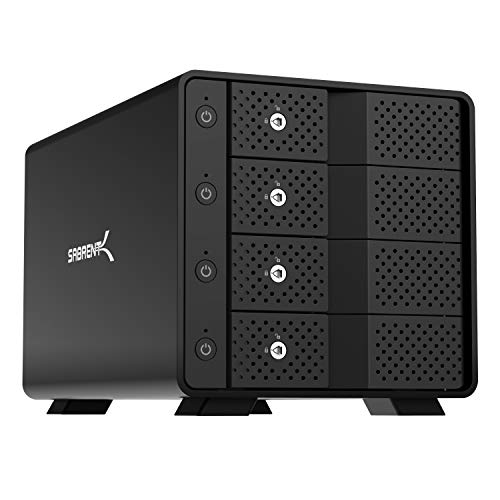
Sabrent 4-Bay USB-C 10Gbps Hard Drive Enclosure (DS-SC4B)
buyers prioritizing 4x 3.5in bays, 10gbps usb-c
Our take Check price for Sabrent 4-Bay USB-C 10Gbps Hard Drive Enclosure (DS-SC4B) (opens in a new tab)
Budget Non-RAID
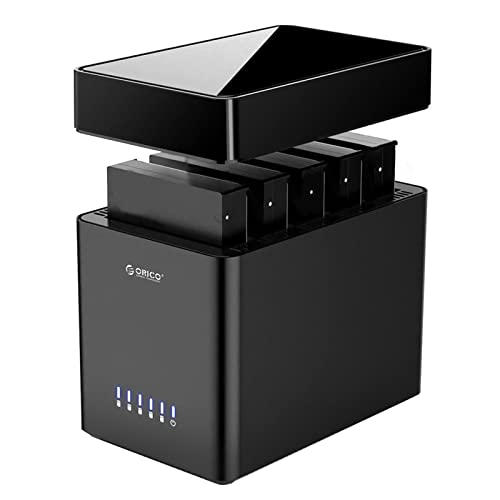
ORICO 5-Bay Hard Drive Enclosure (5Gbps USB 3.0)
5in, up to 110tb total
Our take Check price for ORICO 5-Bay Hard Drive Enclosure (5Gbps USB 3.0) (opens in a new tab)
Best USB-C Non-RAID
ORICO 5-Bay Hard Drive Enclosure (USB-C, 5Gbps)
5in, up to 110tb total
Our take Check price for ORICO 5-Bay Hard Drive Enclosure (USB-C, 5Gbps) (opens in a new tab)

Best Push-Open Design
ORICO 5-Bay USB 3.1 Hard Drive Enclosure (110TB, 12V/10A)
Buyers prioritizing 5-bay, push-to-open design, up to 110tb
Our take Check price for ORICO 5-Bay USB 3.1 Hard Drive Enclosure (110TB, 12V/10A) (opens in a new tab)

Best RAID 5-Bay
ORICO RAID 5-Bay HDD Enclosure (110TB, Aluminum)
Buyers prioritizing 5-bay raid, 8 modes, up to 110tb
Our take Check price for ORICO RAID 5-Bay HDD Enclosure (110TB, Aluminum) (opens in a new tab)

Best High-Capacity RAID
ORICO 5-Bay RAID Enclosure with 150W Built-In Power (110TB)
Buyers prioritizing 5-bay raid, hardware switches, up to 110tb
Our take Check price for ORICO 5-Bay RAID Enclosure with 150W Built-In Power (110TB) (opens in a new tab)

Best Budget RAID Alternative
ORICO 4-Bay RAID Hard Drive Enclosure (88TB, Aluminum)
Buyers prioritizing 4-bay raid, 8 modes, up to 88tb
Our take Check price for ORICO 4-Bay RAID Hard Drive Enclosure (88TB, Aluminum) (opens in a new tab)
Our Picks
Best Non-RAID, Dedicated Per-Bay Controller1 of 8
Sabrent 5-Bay USB-C 10Gbps Hard Drive Enclosure (DS-SC5B) on Amazon (opens in a new tab)
5-inch bays over a 10Gbps USB-C connection, with a rear USB-C port for daisy-chaining a second dock.
Best for
- buyers prioritizing 5x 3.5in bays, 10gbps usb-c
Why we like it
A 120mm PWM temperature-controlled fan only ramps up as drives warm, keeping it quieter during light use while protecting drives during heavy transfers. Like the 4-bay model, it's JBOD-only DAS, not RAID and not a NAS, with a 1-year warranty extendable to 2 years.
Key dimensions & specs
- 5x 3.5in bays, 10Gbps USB-C
- Dedicated ASM1351 controller per bay
- Daisy-chain via rear USB-C port
Pros
- PWM fan only ramps up under load, quieter at idle
- Daisy-chain port for expanding beyond one dock
- Internal auto-switching power supply, no external brick
Cons
- No RAID, individual disks only
- Drives not included
Best 4-Bay Alternative2 of 8
Sabrent 4-Bay USB-C 10Gbps Hard Drive Enclosure (DS-SC4B) on Amazon (opens in a new tab)
5-inch SATA bays gets a stable, independent connection up to 80TB total (4x20TB) over a single 10Gbps USB-C port.
Best for
- buyers prioritizing 4x 3.5in bays, 10gbps usb-c
Why we like it
Drives ship empty and mount individually, JBOD-style, not hardware RAID. Tool-free trays, a locking key, a Kensington slot, and a 92mm active-cooling fan round out a build meant for 24/7 desk use, backed by a 1-year warranty extendable to 2 years.
Key dimensions & specs
- 4x 3.5in bays, 10Gbps USB-C
- Dedicated ASM1351 controller per bay
- JBOD only, no RAID
Pros
- Independent controller per bay avoids one bad drive taking down the bus
- Tool-free trayless hot-swap with lockable bays
- 92mm active cooling for sustained 24/7 use
Cons
- No RAID, individual disks only
- Drives not included
Budget Non-RAID3 of 8
ORICO 5-Bay Hard Drive Enclosure (5Gbps USB 3.0) on Amazon (opens in a new tab)
0 Type-B connection at up to 5Gbps.
Best for
- 5in, up to 110tb total
Why we like it
A 60mm double-ball-bearing fan plus honeycomb rear venting handles cooling, and multi-layer protection (over-voltage, over-current, overheat, short-circuit) guards the drives. ORICO notes that on Linux, multi-bay enclosures like this one can only read one drive at a time, a real platform limitation worth knowing before a Linux-based NAS-replacement plan.
Key dimensions & specs
- 5-bay, 2.5/3.5in, up to 110TB total
- USB 3.0 Type-B, 5Gbps
- 60mm cooling fan
Pros
- Magnetic tool-free covers recognize drives in ~3 seconds
- Multi-layer electrical protection built in
- Supports both 2.5in and 3.5in drives in the same bays
Cons
- Linux limited to reading one drive at a time
- 5Gbps USB 3.0 Type-B, not the newer 10Gbps Type-C tier
Best USB-C Non-RAID4 of 8
ORICO 5-Bay Hard Drive Enclosure (USB-C, 5Gbps) on Amazon (opens in a new tab)
1 Gen 1 Type-C interface, still capped at 5Gbps but with the newer connector shape.
Best for
- 5in, up to 110tb total
Why we like it
The same 60mm cooling fan, honeycomb venting, and multi-layer electrical protection carry over, and ORICO again notes the same Linux one-drive-at-a-time limitation across its multi-bay enclosure line.
Key dimensions & specs
- 5-bay, 2.5/3.5in, up to 110TB total
- USB 3.1 Gen 1 Type-C, 5Gbps
- 60mm cooling fan
Pros
- USB-C connector for broader modern host compatibility
- Same fast 3-second drive recognition as ORICO's USB-A model
- Multi-layer electrical protection built in
Cons
- Still capped at 5Gbps despite the USB-C connector
- Linux limited to reading one drive at a time
Best Push-Open Design5 of 8
ORICO 5-Bay USB 3.1 Hard Drive Enclosure (110TB, 12V/10A) on Amazon (opens in a new tab)
A 12V/10A power supply, notably higher-current than ORICO's other 5-bay models, supports simultaneous read/write across all 5 drives at up to 5Gbps (260MB/s real-world), with an 80mm quiet fan for cooling and extended device longevity.
Best for
- Buyers prioritizing 5-bay, push-to-open design, up to 110tb
Key dimensions & specs
- 5-bay, push-to-open design, up to 110TB
- 12V/10A power supply
- 5Gbps, 260MB/s real-world
Pros
- Push-to-open design is more compact and modern-looking than magnetic covers
- Higher-current 12V/10A supply for stable 5-drive simultaneous operation
- 260MB/s documented real-world speed, not just link-rate claim
Cons
- Still capped at 5Gbps USB 3.1 Gen 1, not the newer 10Gbps tier
- Same Linux one-drive-at-a-time limitation as ORICO's other multi-bay units
Best RAID 5-Bay6 of 8
ORICO RAID 5-Bay HDD Enclosure (110TB, Aluminum) on Amazon (opens in a new tab)
0 transfer speed and a built-in 150W power supply for stable multi-disk operation.
Best for
- Buyers prioritizing 5-bay raid, 8 modes, up to 110tb
Why we like it
An 80mm silent cooling fan with front and rear vents handles the added thermal load of a fifth drive, and the same bracket-free, independently-locked tray design carries over from ORICO's smaller RAID enclosures.
Key dimensions & specs
- 5-bay RAID, 8 modes, up to 110TB
- 235MB/s, built-in 150W power supply
- 80mm cooling fan
Pros
- 8 RAID modes at a larger 5-bay capacity tier
- Built-in 150W power supply avoids a bulky adapter
- Independent locking mechanism per the bracket-free tray design
Cons
- 235MB/s ceiling limits sustained multi-drive throughput
- Back up data before switching RAID modes, per ORICO's own guidance
Best High-Capacity RAID7 of 8
ORICO 5-Bay RAID Enclosure with 150W Built-In Power (110TB) on Amazon (opens in a new tab)
This ORICO 5-bay RAID station uses hardware switches (not software) to configure RAID 0, 1, 3, 5, 10, JBOD, Clone, or Clear across up to 110TB total capacity (22TB per drive), targeting large backup projects, video editing, and media libraries.
Best for
- Buyers prioritizing 5-bay raid, hardware switches, up to 110tb
Why we like it
The built-in 150W power supply keeps voltage stable across 5 simultaneously-running mechanical drives without a bulky external adapter, and a rugged aluminum alloy shell with an 80mm silent fan plus honeycomb venting is engineered for 24/7 long-term operation.
Key dimensions & specs
- 5-bay RAID, hardware switches, up to 110TB
- 150W built-in power supply
- Up to 230MB/s USB 3.0
Pros
- Hardware-switch RAID configuration, no software dependency
- 150W built-in supply keeps a creative studio desk clean and stable
- Engineered specifically for 24/7 long-term operation
Cons
- 230MB/s USB 3.0 ceiling is modest by current multi-gig standards
- Requires physical hardware-switch access for RAID reconfiguration
Best Budget RAID Alternative8 of 8
ORICO 4-Bay RAID Hard Drive Enclosure (88TB, Aluminum) on Amazon (opens in a new tab)
0 interface matched to SATA 6Gbps drives.
Best for
- Buyers prioritizing 4-bay raid, 8 modes, up to 88tb
Why we like it
A built-in 150W power supply avoids a bulky external adapter even with 4 high-consumption mechanical drives running simultaneously, and an 80mm silent cooling fan with front/rear vents handles sustained heat load. A tray-less design with an independent safety lock secures drives against accidental ejection.
Key dimensions & specs
- 4-bay RAID, 8 modes, up to 88TB
- 235MB/s, built-in 150W power supply
- 80mm cooling fan, tray-less lock design
Pros
- Built-in 150W power supply eliminates a bulky external brick
- 8 RAID modes cover backup, capacity, and redundancy use cases
- Independent safety lock prevents accidental drive ejection
Cons
- 235MB/s ceiling is modest for a RAID-capable 4-bay unit
- 22TB per-drive limit caps total capacity below newer competitors
How We Chose
Each pick was assessed across 5 criteria weighted for real-world use.
- Verified whether each product is direct-attached storage (USB, Thunderbolt, or SAS to one host) and whether drives mount individually, in JBOD, or under real hardware RAID, rather than assuming any multi-bay box works the same way.
- Checked the documented USB generation, Thunderbolt generation, or SAS link speed against real sustained throughput figures where manufacturers publish them, rather than repeating theoretical link-rate marketing numbers.
- Distinguished hardware-controller RAID from host-software RAID from plain JBOD/individual-disk presentation, since these have very different failure, portability, and rebuild behavior.
- Weighed tool-free tray design, hot-swap support, fan noise where documented, and daisy-chain or expansion options against the product's likely desk, closet, or rack environment.
- Considered that most DAS enclosures ship diskless, factoring in drive cost, cables, and RAID software where relevant rather than judging price on the empty enclosure alone.
What to Look for in a 5-Bay Direct-Attached Storage
Key buying criteria so you get the right fit the first time.
DAS means direct host attachment, not RAID
USB, Thunderbolt, and enterprise SAS storage can all be DAS. The term describes how the storage connects to a host, not whether it has RAID, what drive type it uses, or how many bays it has.
Bay count is not usable capacity
An 8-bay enclosure with 8x20TB drives does not give you 160TB of usable space in RAID 5 or RAID 6, parity drives eat real capacity. Calculate usable capacity under your intended RAID mode, not raw bay count times drive size.
Hardware RAID and host software RAID are not interchangeable
Hardware/enclosure RAID keeps the array portable across hosts and survives an OS reinstall; host software RAID (or SoftRAID on Mac) ties the array to specific software but is often more flexible and doesn't depend on one controller chip surviving.
The interface link rate is not your real transfer speed
A 10Gbps USB-C enclosure with 5 mechanical HDDs running simultaneously will bottleneck well below 10Gbps once you account for real sustained HDD throughput, typically 150-250MB/s per drive. Multi-drive aggregate speed matters more than the port's rated maximum.
RAID 1 or RAID 5 protects against a single drive failure, not against accidental deletion, ransomware, fire, or theft. Keep a genuine separate backup copy of anything irreplaceable, regardless of how much RAID redundancy your DAS provides.
Diskless enclosures need drives budgeted separately
Most multi-bay DAS enclosures ship completely empty. Factor in 2-8 hard drives or SSDs at your target capacity before comparing the enclosure's sticker price against a similarly-priced preconfigured external drive.
How to Choose a 5-Bay Direct-Attached Storage
RAID 5 Capacity Math at 5 Bays
RAID 5 across 5 equal-size drives gives you 4 drives' worth of usable capacity, only 20% lost to parity versus 25% on a 4-drive RAID 5 array or 50% on RAID 1. This capacity efficiency is the real argument for 5-bay over 4-bay when redundancy matters.
Frequently Asked Questions
Do I need all 5 bays filled to use RAID 5?
For RAID 5 specifically, you need a minimum of 3 drives; a 5-bay enclosure lets you configure RAID 5 across any 3, 4, or 5 populated bays depending on the specific controller's flexibility, though check the exact enclosure's supported minimum before assuming partial-bay RAID 5 works.
Does RAID replace the need for a separate backup?
RAID protects against a single drive's hardware failure, but it does not protect against accidental deletion, ransomware, fire, theft, or a controller failure that affects the whole array at once. Keep a genuine separate backup copy of anything you can't afford to lose.
Do DAS enclosures come with drives included?
2 NVMe SSDs depending on the model. Budget for drive cost separately when comparing total price against a preconfigured external drive.
Will any USB-C or Thunderbolt cable give me full DAS speed?
Cable quality and rated bandwidth matter as much as the port. A basic charging-only USB-C cable can bottleneck a 10Gbps or faster enclosure well below its rated speed. Use the cable included with the enclosure, or one explicitly rated for the matching USB or Thunderbolt generation.
Can I add or remove drives from a DAS enclosure without powering it down?
Only if the specific enclosure documents hot-swap support, which most tool-free tray designs in this category do. Always check your specific product's hot-swap capability before removing a drive live, since not every budget enclosure supports it, especially some fixed-RAID-mode units.
Bottom Line
Best overall: Sabrent 5-Bay USB-C 10Gbps Hard Drive Enclosure (DS-SC5B) — best non-raid, dedicated per-bay controller pick in this roundup. See the full verdicts above for every pick, with pros, cons and who each one suits.
Browse all 5-bay direct-attached storage on Amazon — Prime-eligible options with current pricing.