
Buying Guide
The Best KVM Switches for Mac Mini, Compared
We looked at 5 KVM switches for mac mini side by side, with the trade-offs that separate them and who each one suits.
By Jamie Cole, Lead Product Researcher
9 min read5 products evaluated
We may earn a commission from purchases made through links in this guide. Learn more.
Mac Mini's rear-facing ports make cable routing through a KVM switch more visible on a desk than a laptop's side or rear ports typically are, worth planning your desk layout so the switch and its cables don't create visual clutter behind an otherwise clean Mac Mini setup.
Mac Mini's external display support varies by chip generation just like MacBook, the base M-series Mac Mini has historically supported fewer simultaneous external displays than the Pro variant, worth confirming your specific Mac Mini model's display limit before buying a multi-monitor switch.
Quick Picks
Our 5 recommendations at a glance. Tap a pick for the full verdict.

Best KVM Switch for Mac Mini Overall
UGREEN HDMI KVM Switch 1 Monitor 2 Computers, 8K@60Hz, Aluminum
Mac Mini buyers wanting a high-resolution-ceiling switch with reliable, aesthetically matching build quality
Our take Check price for UGREEN HDMI KVM Switch 1 Monitor 2 Computers, 8K@60Hz, Aluminum (opens in a new tab)

Best Dual-Monitor Pick for Mac Mini
UGREEN HDMI KVM Switch 2 Monitors 2 Computers 4K@60Hz, with 4 USB 3.0 Ports
Mac Mini Pro variant owners wanting reliable dual-monitor peripheral switching
Our take Check price for UGREEN HDMI KVM Switch 2 Monitors 2 Computers 4K@60Hz, with 4 USB 3.0 Ports (opens in a new tab)

Best Multi-Monitor Pick for Mac Mini
UGREEN 8K@60Hz HDMI Displayport KVM Switch 3 Monitors 2 Computers, Aluminum
Mac Mini Pro/Max chip owners wanting genuine three-monitor switching capability
Our take Check price for UGREEN 8K@60Hz HDMI Displayport KVM Switch 3 Monitors 2 Computers, Aluminum (opens in a new tab)
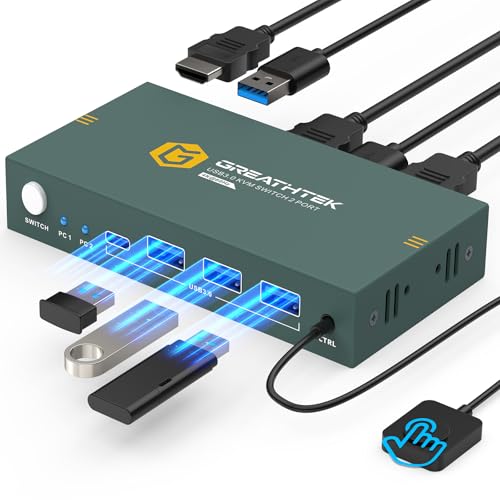
Best Budget Pick for Mac Mini
USB3.0 KVM Switch 2 Port HDMI, 4K@60Hz KVM Switch 1 Monitors 2 Computers with 3 USB3.0 Ports
Budget-conscious Mac Mini buyers wanting to test a KVM switch
Our take Check price for USB3.0 KVM Switch 2 Port HDMI, 4K@60Hz KVM Switch 1 Monitors 2 Computers with 3 USB3.0 Ports (opens in a new tab)
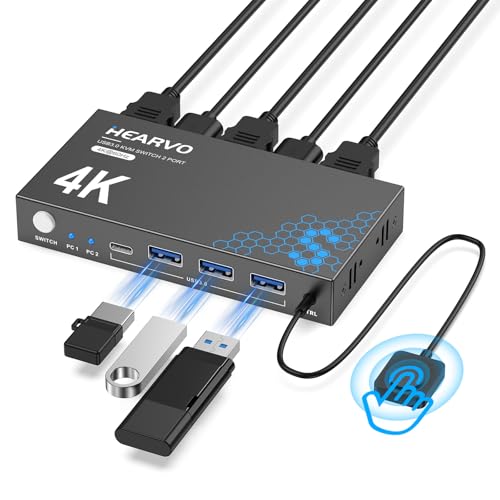
Best Ultra-Budget Pick for Mac Mini
Hearvo USB 3.0 HDMI KVM Switch for 2 Computers 1 Monitor, 4K@60Hz, S7232H
Budget-conscious Mac Mini buyers wanting the most affordable simple KVM switch
Our take Check price for Hearvo USB 3.0 HDMI KVM Switch for 2 Computers 1 Monitor, 4K@60Hz, S7232H (opens in a new tab)
Our Picks
Best KVM Switch for Mac Mini Overall1 of 5
UGREEN HDMI KVM Switch 1 Monitor 2 Computers, 8K@60Hz, Aluminum on Amazon (opens in a new tab)
A high 8K@60Hz resolution ceiling future-proofs this switch well beyond typical Mac Mini display needs, backed by UGREEN's reliable aluminum build that aesthetically complements a Mac Mini desk setup.
Best for
- Mac Mini buyers wanting a high-resolution-ceiling switch with reliable, aesthetically matching build quality
Why we like it
Very high 8K@60Hz resolution ceiling for future-proofing. On price, it comes in below UGREEN HDMI KVM Switch 2 Monitors 2 Computers 4K@60Hz, which is worth weighing if cost is your deciding factor between the two.
On the other side, Single monitor only, not suited for a dual-display setup.
Key dimensions & specs
- 1 monitor, 2 computers
- 8K@60Hz resolution support
- Aluminum build
- HDMI connectivity
Pros
- Very high 8K@60Hz resolution ceiling for future-proofing
- Reliable UGREEN aluminum build quality aesthetically matches Mac Mini
- Compact design helps with cable routing behind the Mini
- Straightforward single-monitor, two-computer switching
Cons
- Confirm your Mac Mini chip generation's external display limit before buying
- Verify EDID emulation behavior specifically confirmed on Mac Mini
- Single monitor only, not suited for a dual-display setup
Best Dual-Monitor Pick for Mac Mini2 of 5
UGREEN HDMI KVM Switch 2 Monitors 2 Computers 4K@60Hz, with 4 USB 3.0 Ports on Amazon (opens in a new tab)
0 ports give real confidence for peripheral switching.
Best for
- Mac Mini Pro variant owners wanting reliable dual-monitor peripheral switching
Why we like it
0 ports for reliable Mac Mini peripheral switching.
On the other side, Verify EDID emulation behavior specifically confirmed on Mac Mini.
Key dimensions & specs
- 2 monitors, 2 computers
- 4K@60Hz resolution support
- 4 USB 3.0 ports
- HDMI connectivity
Pros
- Explicit 4 USB 3.0 ports for reliable Mac Mini peripheral switching
- Dual-monitor support for Mac Mini Pro variants
- 4K@60Hz resolution covers typical display needs
- Good value for the feature combination
Cons
- Requires a Mac Mini chip variant confirmed to support dual external displays
- Higher price than a single-monitor switch
- Verify EDID emulation behavior specifically confirmed on Mac Mini
Best Multi-Monitor Pick for Mac Mini3 of 5
UGREEN 8K@60Hz HDMI Displayport KVM Switch 3 Monitors 2 Computers, Aluminum on Amazon (opens in a new tab)
Supports up to three monitors, appropriate for a Mac Mini Pro or Max chip variant confirmed to support this many external displays.
Best for
- Mac Mini Pro/Max chip owners wanting genuine three-monitor switching capability
Why we like it
On the other side, More complex cable routing behind a Mac Mini setup.
Key dimensions & specs
- 3 monitors, 2 computers
- 8K@60Hz resolution support
- HDMI and DisplayPort connectivity
- Aluminum build
Pros
- Supports up to three monitors for demanding Mac Mini Pro/Max setups
- Both HDMI and DisplayPort connectivity for flexibility
- Very high 8K@60Hz resolution ceiling
- Reliable UGREEN aluminum build quality
Cons
- Requires confirming your Mac Mini chip variant supports three external displays
- Higher price than single-monitor alternatives
- More complex cable routing behind a Mac Mini setup
Best Budget Pick for Mac Mini4 of 5
USB3.0 KVM Switch 2 Port HDMI, 4K@60Hz KVM Switch 1 Monitors 2 Computers with 3 USB3.0 Ports on Amazon (opens in a new tab)
A low-cost switch appropriate for Mac Mini buyers wanting to test whether a KVM switch fits their desk setup before investing in a pricier model.
Best for
- Budget-conscious Mac Mini buyers wanting to test a KVM switch
Why we like it
The real tradeoff against that pick: Verify EDID emulation behavior specifically confirmed on Mac Mini.
0 ports for reasonable peripheral switching. On the other side, Single monitor only, verify your Mac Mini's external display support.
Key dimensions & specs
- 1 monitor, 2 computers
- 4K@60Hz resolution support
- 3 USB 3.0 ports
- HDMI connectivity
Pros
- low-cost price for testing a KVM switch with your Mac Mini
- 3 USB 3.0 ports for reasonable peripheral switching
- 4K@60Hz resolution covers typical display needs
- Good entry point before a pricier commitment
Cons
- Verify EDID emulation behavior specifically confirmed on Mac Mini
- Lower rating than higher-priced picks, verify current reviews
- Single monitor only, verify your Mac Mini's external display support
Best Ultra-Budget Pick for Mac Mini5 of 5
Hearvo USB 3.0 HDMI KVM Switch for 2 Computers 1 Monitor, 4K@60Hz, S7232H on Amazon (opens in a new tab)
The absolute lowest price point in this guide, appropriate for Mac Mini buyers with a simple setup wanting the most affordable reliable option.
Best for
- Budget-conscious Mac Mini buyers wanting the most affordable simple KVM switch
Why we like it
0 KVM Switch 2 Port HDMI.
On the other side, Build quality less proven than higher-priced alternatives.
Key dimensions & specs
- 1 monitor, 2 computers
- 4K@60Hz resolution support
- USB 3.0 connectivity
- Lowest price in this guide
Pros
- Absolute lowest price in this guide
- 4K@60Hz resolution covers typical display needs
- USB 3.0 connectivity for peripheral switching
- Simple, no-frills reliable switching
Cons
- Fewer USB ports than pricier alternatives
- Verify EDID emulation behavior specifically confirmed on Mac Mini
- Build quality less proven than higher-priced alternatives
How We Chose These KVM Switches for Mac Mini
Each pick was assessed across 4 criteria weighted for real-world use.
- Cable routing and desk visibility considered for Mac Mini's rear ports
- Considered that Mac Mini's rear-facing ports make cable routing through a KVM switch more visible on a desk than a laptop's side ports typically are.
- Chip-generation external display limits flagged for Mac Mini specifically
- Flagged that Mac Mini's external display support varies by chip generation, with the base M-series model historically supporting fewer displays than the Pro variant.
- Aesthetic and build quality weighed for a visible desk companion
- Weighed build quality and aesthetics more heavily given a Mac Mini KVM switch typically sits visibly on the desk alongside the compact Mini itself.
- EDID emulation checked for Mac Mini's specific display scaling behavior
- Checked whether EDID emulation is confirmed to work correctly on Mac Mini specifically, given macOS's distinct external display scaling system.
What to Look for in a KVM Switch for Mac Mini
Key buying criteria so you get the right fit the first time.
Verify EDID emulation is included, regardless of price
EDID (Extended Display Identification Data) is the information a monitor sends to a connected computer describing its supported resolutions and refresh rates, and a KVM switch without EDID emulation can cause a real, recurring annoyance: when you switch away from a computer, that computer loses its connection to the monitor's EDID data, and some graphics drivers respond by dropping to a default low resolution or losing the display arrangement entirely until you manually reconfigure it after switching back.
A switch with proper EDID emulation stores and continuously presents the monitor's display information to every connected computer regardless of which one is actively selected, so switching back and forth doesn't repeatedly trigger resolution resets or display rearrangement.
This feature isn't reliably tied to price, a budget switch can include it while a similarly priced competitor omits it, so check the listing or current buyer reviews specifically for EDID emulation rather than assuming it based on price alone.
Match USB peripheral support to what you actually plug in, not just keyboard and mouse
0 or higher) vary significantly beyond that baseline, and this matters concretely if you also want to switch a USB webcam, external drive, audio interface, or other peripheral along with the computer selection rather than leaving it permanently connected to one machine.
0 ports can handle a webcam or external drive at full speed as part of the same switching action.
Count your actual USB peripherals beyond keyboard and mouse, and check both the port count and the stated USB generation against what those specific peripherals need to function at full speed.
Check whether switching happens via hotkey, a physical button, or both, and whether that matches your workflow
KVM switches offer switching through a physical button on the device itself, a keyboard hotkey combination (commonly a specific key pressed a set number of times), or both, and this is a genuine day-to-day usability factor rather than a minor detail, since a physical button requires reaching across or behind your desk setup every time you switch, while hotkey switching lets you change computers without moving your hands from the keyboard at all.
This matters more the more frequently you actually switch between computers during a session, someone switching once or twice a day may not care, while someone switching dozens of times while referencing one machine and working on another benefits meaningfully from hotkey support.
Check whether hotkey switching is explicitly supported and confirm the specific key combination works with your operating system, since some hotkey implementations have compatibility quirks on certain OS versions.
Confirm audio switching is included if you need it, since many KVM switches handle video and USB but not audio
A significant number of KVM switches route video and USB peripherals between computers but do not switch audio output at all, meaning your speakers or headphones stay connected to whichever computer they were originally plugged into regardless of which computer is currently selected for video and keyboard control, a confusing experience if you're not expecting it.
This is a distinct, separately-implemented feature, not something that comes automatically bundled with video and USB switching, so a switch's audio support (or lack of it) needs to be checked explicitly rather than assumed.
If you regularly use audio output and want it to follow the same switching action as your monitor and keyboard, check the listing specifically for stated audio switching support rather than assuming any KVM switch handles this by default.
Check physical port placement and cable routing, since a technically capable switch can still be annoying to use daily
Beyond core specs like resolution support and port count, the physical layout of a KVM switch's ports on its housing meaningfully affects how pleasant it is to actually live with on a desk: ports crammed close together can make thick HDMI or USB-C cables difficult to seat fully, and ports facing an awkward direction relative to how the switch sits on or under your desk can turn routine cable management into a recurring frustration that a spec sheet never reveals.
This is exactly the kind of detail that only shows up in real photos of the actual unit or in buyer reviews mentioning cable fit and port spacing, not in the resolution and port-count specs that dominate most listings.
Look at actual product photos showing port placement and spacing before buying, and check reviews specifically for mentions of cable clearance issues if you're using thicker high-speed cables.
How to Choose a KVM Switch for Mac Mini
Port count isn't consistently confirmed across every pick in this comparison; check each listing's product details directly.
| 0 HDMI KVM Switch for 2 Computers 1 Monitor | |
| UGREEN HDMI KVM Switch 1 Monitor 2 Computers | |
| No firm budget ceiling, prioritizing build or resolution | UGREEN 8K@60Hz HDMI Displayport KVM Switch 3 Monitors 2 Computers |
Hotkey Switching vs Physical Button Only
- Switches computers without reaching for the device, faster for frequent switching during a work session. In this comparison: check each listing's switching method directly.
- Simpler and more predictable, but requires reaching the device every time you switch. In this comparison: UGREEN HDMI KVM Switch 1 Monitor 2 Computers, UGREEN HDMI KVM Switch 2 Monitors 2 Computers 4K@60Hz, UGREEN 8K@60Hz HDMI Displayport KVM Switch 3 Monitors 2 Computers.
| 0 speed for drives or webcams | UGREEN HDMI KVM Switch 2 Monitors 2 Computers 4K@60Hz |
|---|---|
| Basic keyboard and mouse only | UGREEN HDMI KVM Switch 1 Monitor 2 Computers |
- Explicit confirmation of audio switching in the listing, since many KVM switches handle video and USB but leave speakers or headphones tied to one fixed computer.
- No pick in this specific comparison explicitly confirms audio switching; check our dedicated audio-support KVM switch roundup if that's a hard requirement.
- You want what UGREEN 8K@60Hz HDMI Displayport KVM Switch 3 Monitors 2 Computers offers: Supports up to three monitors for demanding Mac Mini Pro/Max setups. That's a real functional upgrade over the budget picks here, not just a brand markup.
- 0 HDMI KVM Switch for 2 Computers 1 Monitor already covers the essentials: Absolute lowest price in this guide. The main thing you'd be paying extra for elsewhere in this list is resolution headroom or build quality you may not need.
Frequently Asked Questions
Does Mac Mini's port placement make KVM switch cabling messier?
It can, rear-facing ports make cable routing more visible than a laptop's side ports typically are, plan your desk layout accordingly.
How many external displays can my Mac Mini support?
It depends on your chip generation, the base M-series model has historically supported fewer displays than the Pro variant, verify your specific model.
Does EDID emulation work the same on Mac Mini as MacBook?
It should behave similarly since both run macOS, but verify this is confirmed for your specific switch through current reviews.
Is a budget KVM switch good enough for a Mac Mini setup?
For basic needs, yes, but verify EDID emulation and your Mac Mini's external display limit regardless of price.
Bottom Line
Best overall: UGREEN HDMI KVM Switch 1 Monitor 2 Computers, 8K@60Hz, Aluminum — best kvm switch for mac mini overall pick in this roundup. See the full verdicts above for every pick, with pros, cons and who each one suits.
Browse all kvm switches for mac mini on Amazon — Prime-eligible options with current pricing.