
Buying Guide
The Best Ergonomic Keyboards for a Cleaner, More Useful Desk
We looked at 7 ergonomic keyboards side by side, with the trade-offs that separate them and who each one suits.
By Jamie Cole, Lead Product Researcher
10 min read7 products evaluated
We may earn a commission from purchases made through links in this guide. Learn more.
An ergonomic keyboard covers a wider range of designs than most buyers expect, from a one-piece wave layout that gently curves the keys apart to a true split keyboard whose two halves separate shoulder-width. That range matters because a wave keyboard and a full split keyboard solve different problems and demand a different adjustment period, so the right pick depends on how much your wrists actually need to change position, not just on price.
95 wireless split keyboard built for business use.
Quick Picks
Our 7 recommendations at a glance. Tap a pick for the full verdict.

Best True Split Wireless
Logitech Ergo K860 Wireless Ergonomic Split Keyboard with Wrist Rest
Buyers who want a genuine split shape with negative tilt built in
Our take Check price for Logitech Ergo K860 Wireless Ergonomic Split Keyboard with Wrist Rest (opens in a new tab)

Best Budget Entry Point
Logitech Wave Keys Wireless Ergonomic Keyboard - Graphite
First-time buyers easing into an ergonomic layout without a steep learning curve
Our take Check price for Logitech Wave Keys Wireless Ergonomic Keyboard - Graphite (opens in a new tab)

Best Adjustable Tenting
Arteck Split Ergonomic Keyboard with Cushioned Wrist and Palm Rest
Buyers who want adjustable tenting without paying for a premium split board
Our take Check price for Arteck Split Ergonomic Keyboard with Cushioned Wrist and Palm Rest (opens in a new tab)

Best Color Alternative
Logitech Wave Keys Wireless Ergonomic Keyboard with Cushioned Palm - Sand
Buyers who want the Wave Keys ergonomics in a lighter finish
Our take Check price for Logitech Wave Keys Wireless Ergonomic Keyboard with Cushioned Palm - Sand (opens in a new tab)

Best Budget Wired Split
Perixx PERIBOARD-512B Wired Ergonomic Keyboard
Buyers who want to try a split layout on a fixed desk without spending much
Our take Check price for Perixx PERIBOARD-512B Wired Ergonomic Keyboard (opens in a new tab)

Best Premium Build
Microsoft Surface Ergonomic Wireless Keyboard
Buyers who want premium materials in a wave-style keyboard
Our take Check price for Microsoft Surface Ergonomic Wireless Keyboard (opens in a new tab)
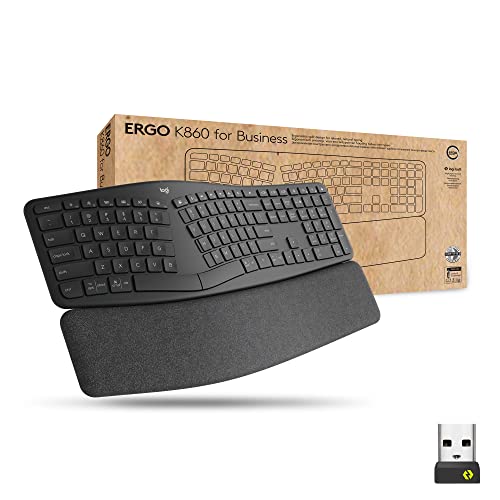
Best for Business Fleets
Logitech Ergo K860 Split for Business Wireless Keyboard - Graphite
IT-managed or business-purchased setups that want the K860's ergonomics with fleet support
Our take Check price for Logitech Ergo K860 Split for Business Wireless Keyboard - Graphite (opens in a new tab)
Our Picks
Best True Split Wireless1 of 7
Logitech Ergo K860 Wireless Ergonomic Split Keyboard with Wrist Rest on Amazon (opens in a new tab)
The Ergo K860 uses a true split layout with a domed, curved center that keeps wrists in a more neutral position than a flat keyboard, paired with a built-in negative-tilt frame that drops the front edge below the back.
Best for
- Buyers who want a genuine split shape with negative tilt built in
Why we like it
That negative tilt is the detail most competing keyboards skip, and it is the single biggest factor in reducing wrist extension while typing.
Negative tilt reduces wrist extension by design. On price, it's actually priced above Logitech Wave Keys Wireless Ergonomic Keyboard, which is worth weighing if cost is your deciding factor between the two.
On the other side, Larger footprint than a compact board.
Key dimensions & specs
- True split, domed layout
- Built-in negative tilt
- Attached cushioned palm rest
- Bluetooth + USB receiver
- Multi-device pairing
Pros
- Negative tilt reduces wrist extension by design
- True split shape, not just a curved single unit
- Attached palm rest needs no separate purchase
- Works across multiple paired devices
Cons
- Pricier than wave-style alternatives
- Fixed split angle, halves don't fully separate
- Larger footprint than a compact board
Best Budget Entry Point2 of 7
Logitech Wave Keys Wireless Ergonomic Keyboard - Graphite on Amazon (opens in a new tab)
Wave Keys is a one-piece wave-shaped board rather than a true split, meaning the keys curve gently apart but the two halves stay fixed together.
Best for
- First-time buyers easing into an ergonomic layout without a steep learning curve
Why we like it
That makes it a much easier first step for someone who has never used an ergonomic layout, with a far shorter adjustment period than a full split keyboard.
On the other side, No adjustable tenting angle.
Key dimensions & specs
- One-piece wave layout
- Built-in cushioned wrist rest
- Wireless, AAA battery powered
- Bluetooth or USB receiver
- Compact footprint vs. split boards
Pros
- Most affordable pick in this list
- Easiest adjustment period of any pick here
- Built-in cushioned rest
- Long battery life on standard AAAs
Cons
- Not a true split, halves are fixed together
- Less forearm relief than a full split layout
- No adjustable tenting angle
Best Adjustable Tenting3 of 7
Arteck Split Ergonomic Keyboard with Cushioned Wrist and Palm Rest on Amazon (opens in a new tab)
The Arteck splits into two halves connected by a hinge that supports an adjustable tenting angle, letting each side tilt outward to reduce forearm pronation more than a fixed wave design can.
Best for
- Buyers who want adjustable tenting without paying for a premium split board
Why we like it
On the other side, Tenting hinge adds moving parts to maintain.
Key dimensions & specs
- True split, hinged halves
- Adjustable tenting angle
- Cushioned wrist and palm rest
- 2.4GHz USB wireless
- Compatible with Windows desktop and laptop
Pros
- Adjustable tenting angle at a wave-keyboard price
- True split shape for real forearm relief
- Full-width cushioned rest included
- Low-latency 2.4GHz connection
Cons
- Windows-focused compatibility
- Bulkier than a fixed wave board
- Tenting hinge adds moving parts to maintain
Best Color Alternative4 of 7
Logitech Wave Keys Wireless Ergonomic Keyboard with Cushioned Palm - Sand on Amazon (opens in a new tab)
This is the same Wave Keys design as our budget pick above, built in a lighter Sand colorway for a desk setup that leans neutral rather than graphite or black.
Best for
- Buyers who want the Wave Keys ergonomics in a lighter finish
Why we like it
The wave-shaped key layout and built-in cushioned palm rest carry over unchanged, so the ergonomic behavior is identical to the graphite version.
The real tradeoff against that pick: Same ergonomic limits as the standard Wave Keys.
On the other side, No adjustable tenting angle.
Key dimensions & specs
- One-piece wave layout
- Built-in cushioned palm rest
- Sand colorway
- Wireless, AAA battery powered
- Bluetooth or USB receiver
Pros
- Lighter colorway for neutral desk setups
- Same easy adjustment period as the graphite version
- Built-in cushioned rest
- Long battery life on standard AAAs
Cons
- Same ergonomic limits as the standard Wave Keys
- Not a true split layout
- No adjustable tenting angle
Best Budget Wired Split5 of 7
Perixx PERIBOARD-512B Wired Ergonomic Keyboard on Amazon (opens in a new tab)
The PERIBOARD-512B is the cheapest pick in this list and the only wired option, which removes battery and pairing concerns entirely for a desk that stays in one spot.
Best for
- Buyers who want to try a split layout on a fixed desk without spending much
Why we like it
Its split, curved key field follows the same natural-typing principle as pricier wireless boards, just without the tenting hinge.
On the other side, Basic build compared to premium picks.
Key dimensions & specs
- Split, curved key layout
- Attached wrist rest
- Wired USB connectivity
- US English layout
- No pairing or battery needed
Pros
- Lowest price in this list
- No battery or pairing setup required
- Split curved layout at a budget price
- Attached wrist rest included
Cons
- Wired only, no wireless option
- Fixed angle, no tenting adjustment
- Basic build compared to premium picks
Best Premium Build6 of 7
Microsoft Surface Ergonomic Wireless Keyboard on Amazon (opens in a new tab)
The Surface Ergonomic Keyboard uses a wave-shaped curve with a plush faux-leather palm rest and a domed number pad that keeps the mouse closer to center, reducing reach distance for the right hand.
Best for
- Buyers who want premium materials in a wave-style keyboard
Why we like it
Build quality is the standout here, with a fabric-wrapped deck and a dedicated cutout for a smartphone or tablet stand.
On the other side, No adjustable tenting angle.
Key dimensions & specs
- Wave-shaped layout
- Faux-leather palm rest
- Domed, offset number pad
- Bluetooth wireless
- Fabric-wrapped deck finish
Pros
- Premium materials and finish
- Offset number pad keeps the mouse closer to center
- Plush palm rest
- Reliable Bluetooth pairing
Cons
- Most expensive pick in this list
- Not a true split, so less pronation relief than a hinged board
- No adjustable tenting angle
Best for Business Fleets7 of 7
Logitech Ergo K860 Split for Business Wireless Keyboard - Graphite on Amazon (opens in a new tab)
This is the business-focused edition of the Ergo K860, carrying the same true split, domed shape, and built-in negative tilt as the standard model, with added enterprise pairing and fleet management support through Logitech's business software.
Best for
- IT-managed or business-purchased setups that want the K860's ergonomics with fleet support
Why we like it
The core ergonomic design is unchanged.
The real tradeoff against that pick: Priced above the standard consumer K860.
On the other side, Same fixed split angle as the standard model.
Key dimensions & specs
- True split, domed layout
- Built-in negative tilt
- Business-tier pairing and fleet support
- Bluetooth + USB receiver
- Attached cushioned palm rest
Pros
- Same proven negative-tilt split design as the standard K860
- Business pairing and device management support
- Attached palm rest
- Multi-device Bluetooth pairing
Cons
- Priced above the standard consumer K860
- Business features add no benefit for a single home user
- Same fixed split angle as the standard model
How We Chose These Ergonomic Keyboards
Each pick was assessed across 5 criteria weighted for real-world use.
- Split type and tenting range
- Distinguished true split keyboards, where the halves separate or hinge apart, from one-piece wave designs that curve keys without separating, and noted which picks support an adjustable tenting angle.
- Wrist and palm support quality
- Checked whether a cushioned rest was built in and full-width, since a rest meant only to be leaned on during pauses behaves very differently from one used while actively typing.
- Compared wired, Bluetooth, and USB receiver options, since a wired board removes battery concerns entirely while wireless models add multi-device pairing flexibility.
- Weighed how large a layout change each pick asks of a new user, a one-piece wave board is a much smaller adjustment than a full split, hinged layout.
- Weighed build materials, included rest quality, and tenting adjustability against price, from the wired split board to the premium wave keyboard.
What to Look for in an Ergonomic Keyboard
Key buying criteria so you get the right fit the first time.
Understand what split, curved, and vertical layouts each actually change about your hand position
A curved keyboard bends the key rows into an arc that reduces how far your fingers reach across the board but keeps both hands in a fixed relative position, a split keyboard physically separates the two halves so each hand and wrist can angle independently to a more natural position, and a fully vertical keyboard rotates the hands toward a handshake-like orientation that reduces forearm rotation (pronation) more aggressively than either curved or split designs.
These are meaningfully different interventions, not just cosmetic variations on the same idea, and the amount of adjustment period and the specific relief they provide differs: a curved board requires almost no adaptation, a split board requires learning a new hand spacing, and a vertical board requires the most significant adaptation period but addresses forearm rotation most directly.
If a specific pain type (wrist deviation, forearm rotation, shoulder width) has been identified, match the layout type to that specific issue rather than assuming any keyboard labeled "ergonomic" addresses the same problem.
Check the key switch type, since it affects both typing feel and finger force required
Ergonomic keyboards commonly use one of three switch technologies: membrane (a soft rubber dome under each key, quiet and inexpensive but requiring the key to bottom out fully to register), scissor or low-profile (a shorter, more stable keystroke similar to a laptop keyboard), or mechanical (an individual physical switch per key with more configurable actuation force and travel distance, generally louder but often preferred for tactile feedback and reduced bottoming-out force).
This matters for anyone with existing wrist or finger strain specifically because mechanical switches can be selected for lighter actuation force, requiring less pressure to register a keystroke than a standard membrane keyboard, a genuine factor in repetitive strain rather than just a preference for typing feel.
If finger fatigue or strain is a specific concern, check for stated actuation force (measured in grams) rather than assuming all keyboards require the same finger pressure to type.
Confirm wireless connection type matches your actual devices, and know the battery tradeoffs
4GHz USB receiver (generally lower latency and more reliable than Bluetooth, but requires a free USB port and the receiver can be lost), or wired USB (zero latency and no battery to manage, but no cable-free movement).
Multi-device Bluetooth models that support pairing with several devices and switching between them are a genuine convenience for anyone alternating between a work laptop and a personal computer, but this feature isn't universal even among Bluetooth keyboards.
Check the specific connection type and, for wireless models, confirm multi-device pairing support explicitly if you need to switch between more than one computer regularly, and factor in that backlit wireless models draw more power and need more frequent charging than non-backlit equivalents.
Check for a negative tilt option and separate wrist rest, since flat isn't always neutral
A truly neutral wrist position during typing involves the hands tilting slightly downward from the wrist toward the keys (negative tilt), which is the opposite of the upward tilt most standard and even many "ergonomic" keyboards default to with their built-in feet, and only some ergonomic models offer an actual negative-tilt adjustment or come with a design that achieves this angle by default.
A separate, adequately sized wrist rest matters independently of the keyboard's own tilt, since resting the wrist (not just the palm) on a support surface during typing reduces the upward bend at the wrist that a raised keyboard back otherwise creates.
Check specifically for a stated negative tilt option or a naturally downward-sloping design, and confirm whether a wrist rest is included versus needing to be purchased separately, rather than assuming any "ergonomic" label includes proper tilt geometry.
Weigh review volume against star rating, since some ergonomic keyboards share variants with different genuine track records
Ergonomic keyboards, especially from smaller brands, are frequently sold in multiple color or configuration variants that share the same underlying design and sometimes the same pooled review history despite being technically separate listings, which can make one specific variant's review count look artificially large or, conversely, leave a new design with almost no independent track record despite looking similar to an established model.
A keyboard central to your daily work deserves a design with substantial, focused review history behind it, not just a plausible-looking rating built on a thin or shared sample.
When comparing keyboards, especially similarly-designed variants from the same brand, check both the star rating and the review count together, and read a handful of reviews to confirm they describe the exact variant you're considering.
How to Choose an Ergonomic Keyboard
Every pick in this specific comparison uses a similar layout approach; check the product names above for the exact curve, split, or angle.
| Perixx PERIBOARD-512B Wired Ergonomic Keyboard | |
| Logitech Wave Keys Wireless Ergonomic Keyboard with Cushioned Palm | |
| No firm budget ceiling, prioritizing switch quality or ergonomics | Microsoft Surface Ergonomic Wireless Keyboard |
- Zero input latency and no battery to manage, including no backlight battery drain if illuminated. In this comparison: Perixx PERIBOARD-512B Wired Ergonomic Keyboard.
- Cable-free desk setup, at the cost of battery management and, for Bluetooth, potentially more input latency. In this comparison: Logitech Ergo K860 Wireless Ergonomic Split Keyboard with Wrist Rest, Logitech Wave Keys Wireless Ergonomic Keyboard, Arteck Split Ergonomic Keyboard with Cushioned Wrist and Palm Rest.
By Switch Type and Typing Feel
| Perixx PERIBOARD-512B Wired Ergonomic Keyboard | |
| Tactile feedback, lighter actuation force | Microsoft Surface Ergonomic Wireless Keyboard |
For Wrist Pain or Carpal Tunnel Specifically
- A genuine split or vertical layout (not just a curved surface), a negative tilt option or naturally downward-sloping design, and an included wrist rest sized for your hand.
- Logitech Ergo K860 Wireless Ergonomic Split Keyboard with Wrist Rest fits this specifically: Negative tilt reduces wrist extension by design.
- You want what Microsoft Surface Ergonomic Wireless Keyboard offers: Premium materials and finish. That's a real functional upgrade over the budget picks here, not just a brand markup.
- Perixx PERIBOARD-512B Wired Ergonomic Keyboard already covers the essentials: Lowest price in this list. The main thing you'd be paying extra for elsewhere in this list is adjustability you may not need.
Frequently Asked Questions
How long does it take to adjust to an ergonomic keyboard?
Expect typing speed to drop 20-40% for the first 2-4 weeks, especially on a true split layout like the Ergo K860 or Arteck. A one-piece wave keyboard like the Wave Keys is a gentler adjustment. Give yourself several weeks of regular use before judging comfort or speed.
What's the difference between a wave keyboard and a true split keyboard?
A wave keyboard is one fixed unit that curves the keys apart without separating, offering an easier transition but less forearm relief. A true split keyboard lets the two halves move independently or tent outward, giving more real ergonomic benefit at the cost of a longer adjustment period and larger footprint.
Do I need an ergonomic keyboard if I only type a few hours a day?
Ergonomic keyboards help most with cumulative strain, so the benefit scales with how many hours you type daily. Light, occasional use may not need a full split layout, a wave-style board like the Wave Keys is a reasonable middle ground for moderate daily use.
Will an ergonomic keyboard fix wrist pain on its own?
A keyboard alone rarely solves wrist discomfort if the rest of your desk setup, monitor height, chair height, and mouse position, is still off. Pair a new keyboard with correcting those other factors for the best chance at real relief.
What is tenting and do I need it?
Tenting means tilting the two keyboard halves outward so your palms face more toward each other, reducing forearm twist. Only hinged true split boards like the Arteck in this list support adjustable tenting; if that's a priority, skip the fixed wave options.
Is a wired or wireless ergonomic keyboard better?
A wired board like the Perixx PERIBOARD-512B removes battery and pairing concerns entirely, which suits a desk that never moves. A wireless board like the Ergo K860 adds multi-device pairing flexibility if you switch between a laptop and desktop.
Bottom Line
Best overall: Logitech Ergo K860 Wireless Ergonomic Split Keyboard with Wrist Rest — best true split wireless pick in this roundup. See the full verdicts above for every pick, with pros, cons and who each one suits.
Browse all ergonomic keyboards on Amazon — Prime-eligible options with current pricing.